Author: Gemini, Deep Tide TechFlow
On November 3, the U.S. midterm elections are approaching. Whenever this time comes, the market always stirs up discussion about the "curse of risk assets."
From a macroeconomic logic perspective, midterm elections do indeed affect risk assets, and the core reason lies in "policy uncertainty." Who controls Congress is directly related to core issues such as subsequent fiscal spending, tax policy, regulatory intensity, and the debt ceiling.
These expectations will be priced in by the market in advance before the election; when uncertainty rises, capital will instinctively become cautious, and risk appetite will decline accordingly.
And today's BTC has already been widely co-opted by traditional financial channels, increasingly resembling a high-beta risk asset, and its correlation with U.S. stocks, dollar liquidity, and global risk appetite has clearly strengthened.
Therefore, the changes in policy expectations brought about by the midterm elections will most likely be transmitted to BTC's price action; however, it should be noted that this should not be understood as BTC being directly tied to the election results. It is just that in this cycle, it can be clearly seen that BTC's sensitivity to macroeconomic risk appetite has been maxed out.
So, how much real destructive power has this kind of macroeconomic shock, the midterm elections, had historically?
A Decline With Every Election Does Not Hold
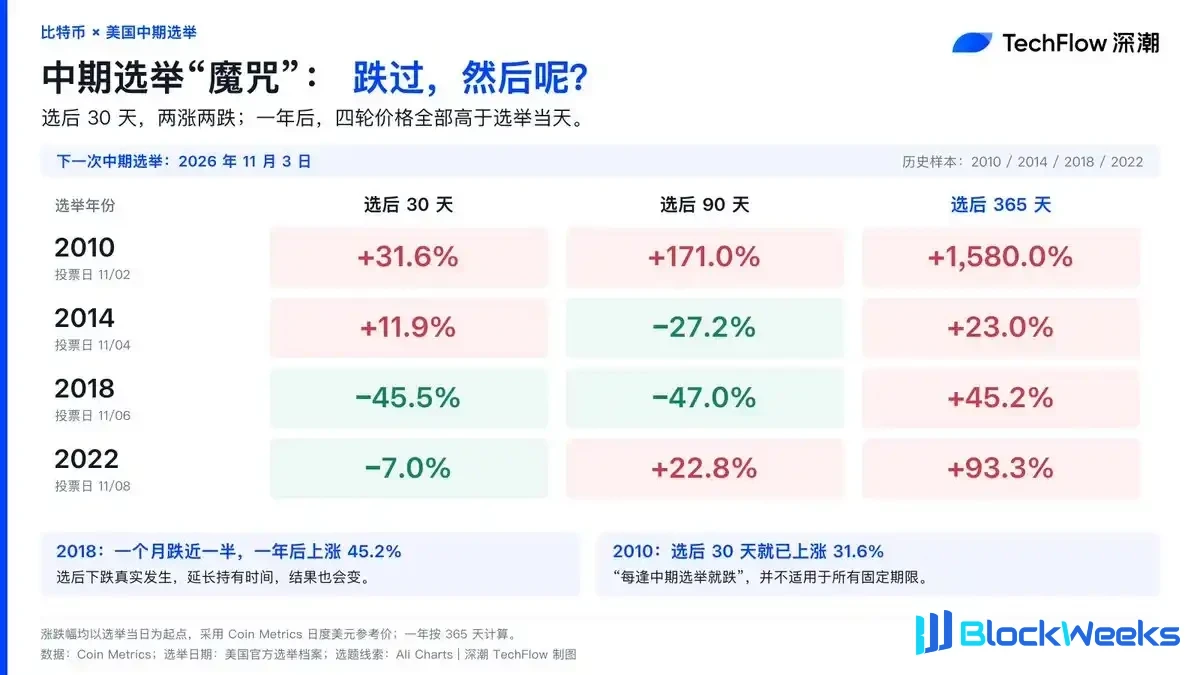
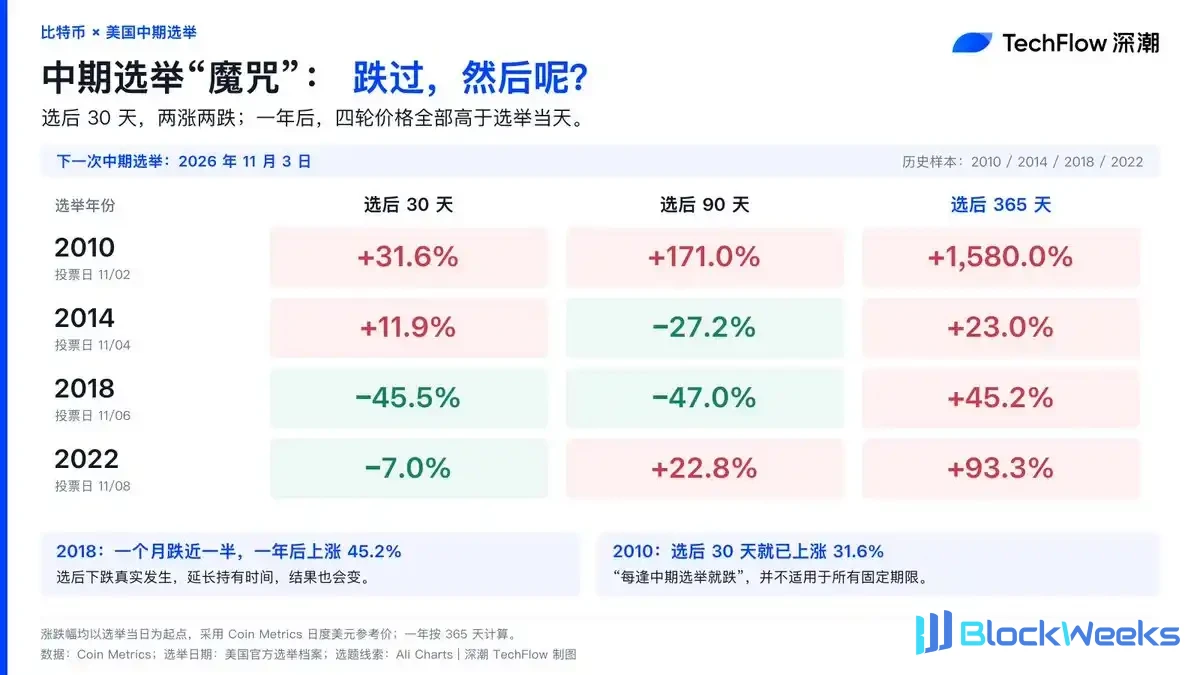
We pulled BTC price action data around the past four U.S. midterm elections (2010, 2014, 2018, 2022), and found that in the real market ledger, the so-called "decline with every midterm" has a cognitive bias when faced with the data.
If we look at the short-term effects of midterm elections, BTC shows violent shakeouts and divergent trends.
In 2018, one month after the election, BTC suffered a brutal shakeout that was nearly a halving, plunging 45.5% in a single month. But at the same time, 30 days after the 2010 election, it directly rose 31.6%.
"It falls with every midterm election" does not apply to all fixed time horizons. This shows that in the short term, the election outcome did not immediately eliminate divergence; instead, it intensified the fierce battle between bulls and bears.
At the same time, this is only one variable, and BTC's market size, acceptance, and macroeconomic conditions are different in each 4-year cycle.
And in terms of long-term performance, in the 1 year after the election, BTC almost achieved absolutely positive returns.
The lowest gain appeared in 2014 (+23.0%), and the highest gain appeared in 2010 (+1580.0%). The most typical case is 2018: the post-election decline did really happen, but the result also changes if the holding period is extended, and one year later it still recorded a positive return of 45.2%.
Liquidity Traps and Chip Redistribution
Large-scale capital is not afraid of long-term policy fluctuations. On the contrary, the short-term macroeconomic uncertainty brought by elections is precisely the natural scenario they use for chip turnover.
When facing risk-aversion sentiment before and after the election outcome, highly leveraged longs in the market and panicked retail investors are highly prone to stampedes, handing over blood-soaked chips during the severe drawdown in the 30 days after the election. And smart money happens to use the liquidity trap created by this macroeconomic noise to take over retail investors' stop-loss selling at low levels and complete long-cycle base position accumulation.
We also mentioned in another article that in the past month, on-chain whales have been accelerating their accumulation of BTC, even setting a new high since February this year.
(Recommended reading: "Who Is Taking Over the Blood-Soaked Chips? On-Chain Data Reveals the Whale Accumulation Wave After BTC Fell Below $81,000")

For BTC, the so-called "midterm election curse" is more like a chip redistribution carried out using macroeconomic noise. Funds that exit due to short-term macroeconomic panic ultimately easily become someone else's excess returns one year later in their financial reports.
(Risk warning: The historical data sample is only four times and is relatively limited. The current dollar interest rate environment, ETF capital structure, and past cycles have significant differences. This article is only an objective data review and does not represent an inevitable future trend. The secondary market needs to be alert to short-term liquidity risks.)