


This Issue's Highlights
The statistical period covered by this weekly newsletter is November 6, 2026 - November 13, 2026.
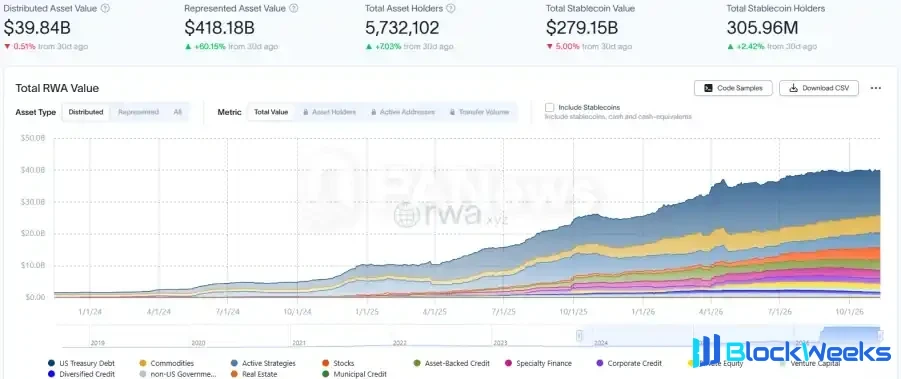
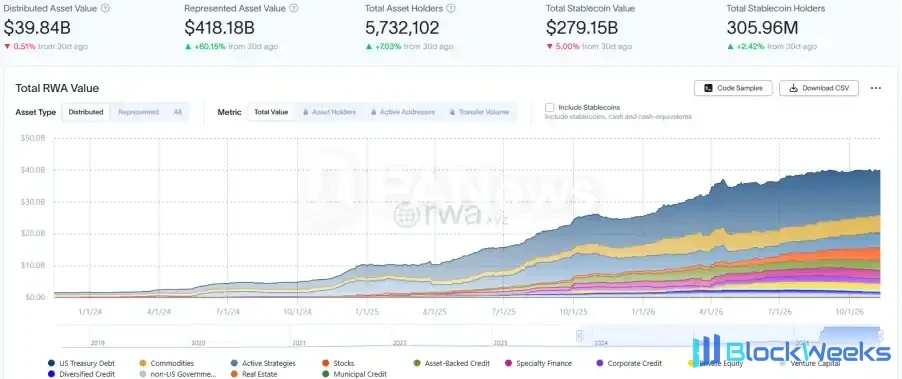
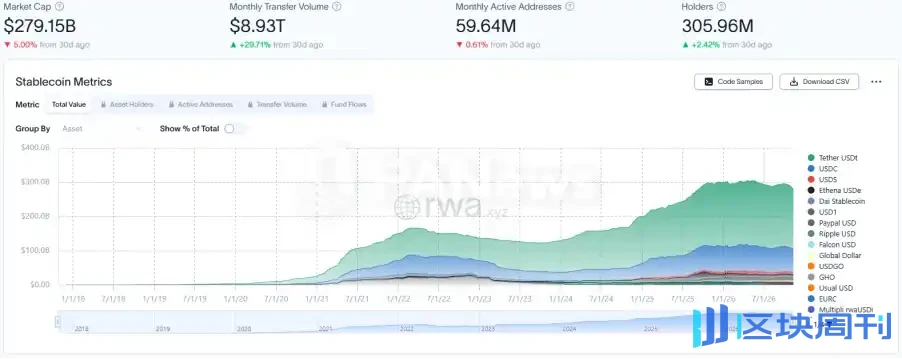
This week, the total on-chain market capitalization of RWA fell slightly to USD 39.84 billion, down 0.51% month-on-month, while asset holders grew to 5.7321 million, up 7.03% month-on-month, showing a divergent pattern of contracting asset stock but continuously expanding user scale; the total market capitalization of stablecoins fell to USD 279.15 billion, monthly transfer volume rose 29.71% month-on-month, the total number of holders reached 306 million, and monthly active addresses declined slightly, presenting characteristics of shrinking total supply, recovering on-chain fund transaction activity, and moderate user growth.
On the regulatory front, the U.S. Treasury plans to require stablecoin issuers to conduct counterparty due diligence at the same standard as banks; the European Central Bank, together with the European Commission and ESMA, is soliciting members for the European Tokenization Standards Group, while warning that legislative delays may postpone the 2029 launch timetable for the digital euro.
On the industry side, multiple technical routes for tokenized stocks are accelerating toward implementation: OKXICE's TSV platform is scheduled to launch on November 23, opening more than 70 types of tokenized assets to compliant U.S. users; the New York Stock Exchange has determined to use Avalanche as the settlement underlying layer for tokenized stocks; Payward, the parent company of Kraken, is about to launch xStocks tokenized products for more than two hundred European and UK stocks; and Solana ecosystem's Formation Securities has also filed with the SEC a plan to build a tokenized securities trading venue.
Traditional financial institutions continue to increase their RWA commitments: Deutsche Bank and its subsidiary DWS are jointly exploring tokenized money market funds; Goldman Sachs, Citigroup, and several other international banks have collectively committed approximately USD 270 million to a joint stablecoin project; Securitize, on the one hand, has partnered with Ethena to launch an all-weather liquidity tool for BlackRock's BUIDL, and on the other hand plans to acquire institutional financing platform River One to connect stablecoins with the traditional credit market.
Data Perspective
RWA Sector Panorama
The latest data disclosed by RWA.xyz shows that as of November 13, 2026, the total on-chain market capitalization of RWA reached USD 39.84 billion, a slight decline of 0.51% compared with the same period last month. The total number of asset holders climbed to 5.7321 million, up 7.03% compared with the same period last month, presenting a characteristic of divergence between the value of existing assets and user scale.
Stablecoin Market
The total market capitalization of stablecoins reached USD 279.15 billion, down 5% compared with the same period last month; monthly transfer volume was USD 8.93 trillion, significantly up 29.71% compared with the same period last month; the total number of monthly active addresses was 59.64 million, down slightly 0.61% compared with the same period last month; and the total number of holders reached 306 million, up 2.42% compared with the same period last month. This month, the fund circulation activity in the stablecoin sector improved significantly, indicating a recovery in demand for fund turnover, but the total existing supply contracted, and the pace of new user penetration was moderate, presenting characteristics of "contracting stock, recovering transactions, and slow user growth."
The leading stablecoins are USDT, USDC, and USDS, among which USDT's market capitalization decreased 4.46% compared with the same period last month; USDC's market capitalization declined 4.42% compared with the same period last month; and USDS's market capitalization increased slightly 0.01% compared with the same period last month.
Regulatory News
U.S. Treasury Proposes to Impose Bank-Equivalent Counterparty Due Diligence on Stablecoin Issuers
According to Bloomingbit, the U.S. Treasury is pushing a plan to impose counterparty due diligence requirements on stablecoin issuers at the same level as banks. The core of the proposal is to require stablecoin issuers to bear the same counterparty due diligence obligations as U.S. banks, in order to tighten verification standards for stablecoin issuers. Specific details, including the implementation timetable and the scope of entities and activities covered, have not yet been disclosed.
European Central Bank, Together with European Commission and ESMA, Solicits Members for Tokenization Standards Group
The European Central Bank, together with the European Commission and the European Securities and Markets Authority (ESMA), announced that it is soliciting members for the European Tokenization Standards Group (ETSG) from the wholesale financial industry, with a deadline of November 27. The group will formulate unified standards for the tokenized financial ecosystem, establish a compliance monitoring framework, and may make recommendations to EU authorities on how to incentivize compliance. The ETSG will be chaired by an industry figure, with the above three parties serving as observers. The Market Integration and Supervision Package (MISP) proposed by the European Commission in December 2025 requires post-trade institutions to promote interoperability between DLT infrastructures and establish corresponding technical standards.
European Central Bank Warns: Legislative Delay May Postpone 2029 Digital Euro Launch Plan
According to Cointelegraph, European Central Bank Executive Board member Piero Cipollone warned EU lawmakers that if digital euro legislation cannot be finalized for a long time, it may postpone its originally scheduled 2029 launch plan. He called on EU negotiators to reach an agreement on digital euro legislation by the end of the year, and stated that legislative delays may deepen Europe's dependence on foreign payment providers. The European Central Bank plans to prepare for a possible first issuance in 2029 if the EU passes regulations this year, and whether and when to issue will be decided by the bank's Governing Council after legislation is passed. The European Central Bank is preparing to launch a 12-month pilot in the second half of 2027.
New Zealand FMA Proposes to No Longer Treat Compliant NZD Payment Stablecoins as Financial Products
The New Zealand Financial Markets Authority (FMA) issued an announcement soliciting opinions on the regulatory path for payment stablecoins denominated in and backed by the New Zealand dollar. According to the proposal, the FMA intends to use a class designation approach so that such stablecoins meeting specific requirements and safeguards are no longer treated as financial products under the Financial Markets Conduct Act (FMC Act). Eligible stablecoins must be fully backed by New Zealand dollars deposited in New Zealand-registered banks and redeemable at par value. FMA General Counsel Liam Mason said that stablecoins are usually designed more like a means of payment rather than an investment. The FMA stated that no decision has yet been made, and the proposal is a transitional measure while broader work on digital asset regulation is underway. The comment period will close on December 18.
Thailand Proposes Daily Cap of About USD 148,000 on Stablecoin Transfers
According to Finance Feeds, the Securities and Exchange Commission (SEC) of Thailand issued a draft on November 12 proposing to limit each customer's daily stablecoin deposit and withdrawal amounts at regulated digital asset operators to 5 million Thai baht (about USD 148,000) respectively, and to restrict transfers to third-party wallets, while strengthening supervision of cryptocurrency market makers. The draft aims to prevent stablecoins from being used for money laundering, cybercrime, and circumvention of international fund transfer regulations. Public consultation will continue until November 26.
According to the draft, customers' daily stablecoin deposit and withdrawal limits will be calculated separately, and transfers must be consistent with the customer's income and financial situation. Transfers of funds between the same customer's accounts at SEC-regulated operators may be exempted. In addition, the regulator will prohibit stablecoin deposits from third-party accounts or wallets, as well as withdrawals to others' wallets. Licensed exchanges must publicly disclose their market maker identities and supported assets, and are responsible for monitoring market maker activities.
Local Observations
JD Coinlink Official Website Apparently Offline; Previously Did Not Obtain Hong Kong's First Batch of Stablecoin Licenses
The official website of JINGDONG Coinlink Technology Hong Kong Limited, JD's stablecoin issuance entity, is currently inaccessible, and the specific time of going offline is uncertain. According to Qichacha information, the company's current enterprise status is still "Still Registered." JD previously announced plans to issue a stablecoin pegged 1:1 to the Hong Kong dollar in Hong Kong. JD Coinlink was selected into the Hong Kong Monetary Authority's stablecoin issuer sandbox in July 2024, but the first batch of stablecoin issuer licenses issued by the Hong Kong Monetary Authority in April this year was granted only to Anchorpoint, a joint venture led by Standard Chartered Bank, and HSBC, with JD Coinlink not among them.
Project Updates
OKXICE tokenized stock platform to launch on November 23, with the first batch of over 70 assets available only to compliant U.S. users
OKXICE TSV, the tokenized securities platform jointly established by OKX and Intercontinental Exchange (ICE), will launch on November 23, offering 24/7 trading only to U.S. users who have completed identity and eligibility verification.
The platform is expected to list more than 70 digital assets linked to stocks and ETFs. The first batch covers seven crypto-related corporate underlying assets such as Coinbase and Robinhood, as well as Strategy preferred shares, and also includes 59 ETFs under Direxion. Not all assets will be available on the first day. Trading is based on OKX's Ethereum L2 network X Layer and matched through Uniswap v4 AMM liquidity pools. The tokens are pegged 1:1 to the underlying securities, and holders enjoy equivalent rights such as dividends and voting.
Currently, 67 listed companies including Meta and Palantie have opposed stock tokenization. Most of the entities approved in the first batch are related to the crypto industry, and the platform will subsequently announce more issuers and assets.
DTCC plans to connect its tokenization service to the Solana network in the second half of 2027
Solana posted that the U.S. Depository Trust & Clearing Corporation (DTCC) plans to connect its tokenization service to the Solana network, with the integration expected to go live in the second half of 2027.
Earlier reports said that DTCC's tokenization service had launched, initially supporting 34 securities.
NYSE to use Avalanche blockchain to settle tokenized stocks
According to The Wall Street Journal, the New York Stock Exchange (NYSE) announced on Monday that its upcoming 24/7 tokenized securities trading platform will use only the Avalanche blockchain to settle tokenized stocks. The platform will use the NYSE's existing technology to match trades and then settle instantly through Avalanche. The platform still requires regulatory approval and aims to launch in the fourth quarter. The NYSE submitted an approval application for the platform in January this year.
Deutsche Bank and its subsidiary DWS sign memorandum to explore products such as tokenized money market funds
According to The Block, Deutsche Bank officially announced on November 11 the launch of its digital asset custody (DAC) service. Clients can custody BTC, ETH, USDC, EURC and EURAU with the bank and transfer them to other institutions. At the same time, Deutsche Bank signed a memorandum of understanding with its asset management company DWS to explore, based on the DAC platform, custody, settlement, liquidity management and distribution arrangements related to tokenized money market funds, crypto asset ETCs and stablecoins. DWS Chief Product Officer Manfred Bauer said the company plans to launch a tokenized money market fund. As of September 30, DWS had assets under management of 1.22 trillion euros.
Kraken parent company Payward to launch tokenized versions of more than 200 UK and European stocks
According to The Wall Street Journal, Nasdaq-backed Payward will launch tokenized versions of more than 200 popular UK and European stocks. Shares of companies such as Siemens, Shell and LVMH will be traded 24/7 as digital tokens through Payward's tokenized stock framework xStocks.
Payward said all stocks in the London FTSE 100 Index and the German DAX Index will be included in the tokenization scope. Starting Wednesday, investors can trade these tokenized stocks on Payward's Kraken platform and other exchanges.
Securitize and Ethena collaborate to launch a $100 million BlackRock BUIDL liquidity tool
According to The Block, Securitize and Ethena Labs launched a $100 million, 24/7 liquidity tool for BlackRock's BUIDL. The tool allows eligible investors to redeem shares of the tokenized fund for supported stablecoins (including USDC) outside traditional market trading hours. The liquidity tool had initial liquidity of $50 million at launch, split equally between BUIDL and USDC; as liquidity is used, another $50 million in funds can be replenished within one hour.
Tokenization platform Centrifuge launches tokenized Schroders emerging markets bond fund product on Solana
According to Ledger Insights, tokenization platform Centrifuge, through its asset management affiliate Anemoy, launched on Solana a tokenized feeder fund for the Schroders International Selection Fund (SISF) Emerging Markets Bond Fund. The product uses a "wrapped" model, with subscriptions and redemptions settled in USDC, and a minimum subscription threshold of $100,000 for non-U.S. professional investors. Schroders manages more than $1 trillion in assets. Centrifuge has previously used a similar feeder fund model to bring products from institutions such as Apollo and New York Life on-chain.
Anthropic tokenized stock ANT to land on Solana on its first day of listing
Backpack Onchain posted on X that Anthropic tokenized stock ANT, issued by Backpack Securities, will trade on Solana through Sunrise after Anthropic lists on Nasdaq, and users will be able to buy and sell Anthropic shares between traditional brokerages and Solana from the first day of listing. Sunrise also posted that ANT will be open for 24/7 trading across Solana markets from the first day of listing. Anthropic previously said it expects its IPO to be priced next Wednesday and to begin trading next Thursday.
Visa adds Western Union stablecoin USDPT as a VisaNet settlement asset
According to The Block, Anchorage Digital announced a partnership with Visa to use some stablecoins issued by its federally chartered bank as native settlement assets on the Visa network, with the first supported being Western Union stablecoin USDPT. Visa and eligible partners can now use USDPT to settle VisaNet obligations, and the two sides will also establish a framework to evaluate the inclusion of more stablecoins issued by Anchorage. USDPT was launched on Solana in May this year and is issued and custodied by Anchorage Digital Bank.
Stablecoin protocol Saturn opens Season 1 and Season 2 airdrop registration, deadline November 16
Saturn, a stablecoin protocol built on Strategy's STRC, announced on X that registration for its Season 1 and Season 2 airdrops is now open, with a deadline of 22:00 Beijing time on November 16. Saturn said registration is not claiming; claiming will open at TGE, and the claim link will only be published by its official X account. Users need to connect the wallet that accumulated Saturn points, sign and verify their Discord account to complete registration. Each Discord account can bind only one wallet, and the Discord account must have been registered for at least 5 days and completed email verification. Users in restricted jurisdictions such as the United States, United Kingdom, European Union and European Economic Area, as well as OFAC-sanctioned addresses, are not eligible.
Zama spin-off project Raycash launches privacy stablecoin payment app on Ethereum
According to The Block, Raycash, a stablecoin payment app spun off from confidential computing protocol Zama, has launched on the Ethereum mainnet and opened a private beta. This is the first retail payment product based on the Zama protocol. Users can convert USDC 1:1 into confidential tokens, hiding balances and transfer amounts during on-chain peer-to-peer payments. They can also earn yield on idle funds within the app through Morpho. Network fees are paid by the app on behalf of users, so users do not need to hold ETH. The project said its waitlist exceeded 75,000 people before launch and that access will be opened in phases.
U.S. stock token trading platform MSX lists 4 new U.S. stock tokens
U.S. stock token trading platform MSX has listed spot and contract trading for U.S. lidar manufacturer AEVA, U.S. semiconductor equipment company ONTO, video game publisher $TTWO and Vanguard S&P 500 ETF $VOO.
Funding Updates
Goldman Sachs, Citi and other financial institutions commit about $270 million to a joint stablecoin project
According to Bloomberg, people familiar with the matter said financial institutions including Goldman Sachs, Citi, Santander and Deutsche Bank have committed about $270 million to a joint stablecoin project.
Tokenization platform Securitize plans to acquire financing platform River One
According to an official announcement, tokenization platform Securitize (SECZ) has signed a definitive agreement to acquire New York-based institutional asset-backed financing platform River One. Financial terms of the transaction were not disclosed, and it is expected to close in the fourth quarter of 2026. Founded in 2025 and incubated by Framework Ventures, River One received investment from Framework Ventures and Maple Finance. It mainly provides warehouse financing for interest-bearing assets such as small business loans and receivables, aiming to connect stablecoin capital with traditional lending markets.
On the same day, Securitize released its third-quarter financial report, with revenue of $18.6 million, up 13% year over year; net loss was $66.3 million, of which about $60 million was non-cash expenses related to its merger and listing; the average scale of tokenized assets on the platform reached $5 billion, up 39% year over year.
Insight Highlights
Former Polychain Partner Starts a Company: Entering Tokenized Real Estate, Securing a $50 Million Seed Round to Build the Real Estate World's "S&P 500"
PANews summary: Index Industries, co-founded by a former Polychain partner, has completed a $50 million seed round, aiming to build a real estate version of the S&P 500 and launching a daily-updated USHP home price index as well as tokenized products USHP and a yield version USHPi. The products are backed by housing-related reserve assets and provide only home price exposure rather than home ownership.
Historically, CME housing price futures faded into obscurity due to basis risk, lack of counterparties, and insufficient liquidity. The new project introduces institutional capital and market makers to improve liquidity, but reserve liquidation, redemption pressure, and sustained secondary-market trading demand still need to be verified through real operation.
Morph Report: 56% of Respondents Have Used, Implemented, or Evaluated Stablecoins—What Else Is Missing for Enterprise Payments?
PANews summary: Morph conducted a survey of 150 cross-border payment practitioners across five Asian markets. 56% of respondents have used, implemented, or evaluated stablecoins, but actual users account for only 10%, with most still in the evaluation stage. Surveyed enterprises generally encounter cross-border payment pain points: 83% say international payments take at least two business days to reach local bank accounts, and 65% say foreign exchange and payment costs consume at least 3% of international business revenue; enterprises place high importance on indicators such as payment tracking, transparent pricing, and total cost.
The report proposes five evaluation dimensions: fund arrival timeliness, total cost, reconciliation visibility, service continuity, and local adaptation, indicating that on-chain transfer speed does not equal a complete business experience. For stablecoins to achieve large-scale adoption in enterprise payments, the entire chain—including exchange and withdrawal, financial reconciliation, and more—needs to be connected.
The Last Mile of Tokenization Is Not On-Chain, but in the Risk Ledger
PANews summary: DTC, under DTCC, launched the tokenization service DTS and obtained a three-year narrow-scope testing authorization from the SEC. It can create digital twins of custodied securities, divided into three layers: registration, transfer, and recognition. The registration layer has already been proven, but DTS itself does not recognize tokens as having collateral or settlement value; the recognition layer must be completed by each bank individually. Societe Generale took the lead in accepting tokenized U.S. Treasuries as eligible collateral, while Morgan Stanley postponed its related trading system.
The service allows 24/7 same-chain transfers only for registered wallets, while cross-chain and form conversion are constrained by business-day windows; the United States focuses on asset tokenization, while Hong Kong's EnsembleTX focuses on tokenized central bank money to complete interbank settlement.
The real difficulty of tokenization is not on-chain issuance, but institutional recognition at the risk ledger level. Collateral mobility may be the core short-term scenario, while multiple risks also exist, including regulatory timing and liquidity fragmentation.