Written by: KarenZ, Foresight News
The U.S. Treasury Department's restrictions on MEXC start with the transfer of funds between it and U.S. financial institutions.
On November 6, the Financial Crimes Enforcement Network (FinCEN) of the U.S. Treasury Department ordered relevant U.S. financial institutions to stop transfers of funds with MEXC Global. The prohibition will take effect 30 days after formal publication in the Federal Register.
FinCEN stated that from May 2021 to May 2026, MEXC facilitated at least $16.7 billion in fund flows related to sanctions evasion, cybercrime, and other suspected illegal activities. The 24-page order issued by FinCEN also provides more specific investigative details.
This measure is part of Operation Economic Outcast (which can be paraphrased as "Economic Isolation Operation"). The United States launched this operation on August 24, 2026, aiming to cut off sources of revenue and cross-border fund networks supporting the Iranian government through sanctions and financial restrictions, with targets including foreign institutions identified by the U.S. as assisting Iran in evading sanctions. Digital assets are also one of the key focus areas.
This is no longer just an action against a cryptocurrency exchange. What is more noteworthy is that the United States is attempting, through the rules of the traditional financial system, to bring the fund flows of cryptocurrency exchanges within its own regulatory boundaries. For a globally operating exchange, the real risk may not just be fines or restrictions on business in a certain country, but rather the gradual loss of the ability to connect with the global financial system.
Who does this order constrain first?
First, let's look at whom this order actually restricts.
FinCEN issued the administrative order pursuant to Section 9714 of the Combating Russian Money Laundering Act, determining that MEXC Global is involved in Russian illicit finance activities and treating it as a foreign financial institution requiring key precautions against money laundering risks.
But its definition of MEXC Global is not limited to a company registered in Seychelles.
According to the footnote on the second page of the administrative order, FinCEN explicitly lists the following affiliated entities: MEXC Global Ltd and MX Global Ltd in Seychelles; MEXC Estonia OÜ in Estonia; GIDA Technology AG in Switzerland; MXC Global Ltd in the United Kingdom; and MEXC Global Foundation Ltd and MEXC Singapore Pte Ltd, formerly registered in Singapore.
There are two details worth noting here.
First, the above list is not a complete list. FinCEN used the phrase "including but not limited to," meaning that as long as they meet the definition in the order, other MEXC Global affiliated entities, branches, offices, and successor entities operating outside the United States may also be included.
Second, MEXC Global affiliates, subsidiaries, branches, and offices within the United States are explicitly excluded from the definition in this order.
Moreover, FinCEN has provided a specific definition of "Successor Entity": any entity that acquires all or part of the assets of MEXC Global, or continues its business under a new name, may be included.
In other words, simply changing the registered entity, transferring assets, or renaming does not necessarily allow one to evade this order.
So, who needs to comply?
The administrative order stipulates that Covered Financial Institutions may not send funds to MEXC Global, nor may they receive funds from MEXC Global.
The scope of financial institutions here is defined in accordance with U.S. Code of Federal Regulations 31 CFR 1010.100(t), including: banks, securities brokers and dealers, money services businesses (MSBs), telegraph companies, casinos and card clubs meeting specified conditions, entities supervised by state or federal banking regulators, futures commission merchants, commodity introducing brokers, and mutual funds, among others.
Therefore, this is not simply requiring a certain U.S. bank to close MEXC's account, but rather establishing a fund transfer prohibition targeting an entire category of financial institutions regulated by the United States.
It is also necessary to note the effective date: as of November 7, the document issued by FinCEN is still awaiting publication in the Federal Register. The order will take effect 30 days after formal publication, with no preset termination date.
$16.7 Billion: What fund networks is MEXC Global actually involved in?
$16.7 billion is the most eye-catching figure in this incident, but if it is treated merely as a total amount, one will miss the truly valuable information in the administrative order.
FinCEN set the investigation period from May 2021 to May 2026 and assessed that MEXC Global facilitated at least $16.7 billion in fund flows related to Russian sanctions evasion, Iran-related entities, North Korean money laundering networks, ransomware, and other cybercriminal activities.
Transactions with sanctioned Russian exchanges have still not ceased
Russia-related funds are the core legal entry point of this administrative order.
FinCEN assessed that from May 2021 to May 2026, MEXC Global was involved in nearly $1.5 billion in fund flows related to Russian sanctions evasion, including $232 million in direct transactions with entities sanctioned by the United States, the European Union, or the United Kingdom.
The document specifically named two trading platforms: Garantex and Grinex.
In April 2022, the U.S. Treasury Department added the Russian cryptocurrency trading platform Garantex to its sanctions list, citing reasons including providing financial services to ransomware operators and other cybercriminals. In 2025, Grinex, the successor entity of Garantex, emerged. FinCEN pointed out that Grinex was created by Garantex employees for the purpose of continuing to transfer funds after Garantex was sanctioned.
But what is more noteworthy is the subsequent fund flows. According to FinCEN's analysis, after the relevant sanctions were publicly implemented, MEXC Global still conducted approximately $129 million in direct transactions with Garantex and approximately $4.1 million in transactions with Grinex. Moreover, the relevant transactions continued until June 2026.
A7: A payment network connecting Russia, Iran, and North Korea
A7 is a payment service network that claims to be sanctions-resistant, operating through entities such as Old Vector LLC, Garantex, Grinex, InDeFi Bank, and ExVed.
The U.S. Treasury Department believes that this network not only helps Russia-related entities evade financial restrictions, but is also linked to Iran's Revolutionary Guard Corps, North Korea-related personnel, Iran-backed armed groups, and cybercriminals.
On October 1, 2026, the U.S. Treasury Department had already designated the A7 network as a significant transnational criminal organization and imposed sanctions.
And the fund flows between MEXC Global and the A7 network are precisely an important part of this investigation.
FinCEN estimates that MEXC Global facilitated at least $26 million in transactions benefiting the A7 network and sent or received nearly $200 million in funds related to the ruble-pegged stablecoin A7A5.
FinCEN also explicitly named Old Vector LLC, the issuer of A7A5, and its owner Ilan Shor, both of whom are subject to OFAC sanctions.
Iran-related fund chains: more than 40 trading platforms had direct dealings with MEXC
The data for the Iran-related portion is equally astonishing.
FinCEN estimates that from May 2021 to May 2026, MEXC Global was involved in nearly $2 billion in fund flows related to Iran-related persons or known or suspected terrorist organizations, of which $1.87 billion in transaction exposure was directly linked to Iran.
Of this, more than $1 billion consisted of direct transactions between MEXC Global and more than 40 identified Iranian cryptocurrency trading platforms.
FinCEN also identified approximately $22 million in transactions related to the Central Bank of Iran, Iran's Revolutionary Guard Corps, and its Quds Force.
In addition, approximately $36 million in transactions involved the Qassam Brigades in the Gaza region, which is sanctioned by the United States and the United Kingdom, and other Iran-linked organizations.
It is worth noting that MEXC's user agreement had previously prohibited individuals or entities in the Iran region from using the platform, but FinCEN believes that these provisions did not effectively prevent the relevant transactions.
North Korea: Small-amount cases are equally critical
In the North Korea section, FinCEN named a North Korean money launderer, Sim Hyon Sop.
The United States imposed sanctions on him as early as April 2023 and publicly identified cryptocurrency addresses associated with him.
But FinCEN believes that between June and September 2025, MEXC Global still helped him receive approximately $350,000.
Cybercrime funding channel: more than $1 million per day
In the cybercrime category, the figures are even larger.
From May 2021 to May 2026, at least $1.99 billion in funds from or flowing to illegal cybercrime entities passed through MEXC Global, averaging more than $1 million per day.
Among them, from January 2022 to July 2024, MEXC Global received more than $37.9 million in suspected ransomware payments, involving more than 125 ransomware variants.
The document even points out that a frequently used ransomware-related deposit address on the platform received more than $1.17 million during the relevant period.
This means that FinCEN's investigation is not only targeting geopolitical sanctions evasion, but also involves multiple directions such as ransomware, darknet markets, fraud proceeds, and stolen funds.
Another larger funding chain: $13 billion in direct dealings with four UK-sanctioned exchanges
If the $16.7 billion reveals the funding links between MEXC Global and multiple countries, organizations, and cybercrime entities, then another set of data in the order further points the investigation toward direct dealings between cryptocurrency exchanges.
FinCEN also pointed out that from May 2018 to July 2026, MEXC Global had more than $13 billion in direct dealings with at least four high-risk exchanges sanctioned by the United Kingdom.
There is one noteworthy aspect of this set of data: the transaction time span is longer. That is to say, FinCEN's tracking of the relevant transactions can be traced back as far as the early days of MEXC Global's establishment.
It should be specially noted that the statistical time periods and transaction counterparties of the above-mentioned funds may overlap.
Why did the United States choose to cut off the funds transfer channel?
The reason given by FinCEN is: simply increasing record-keeping, information collection, and reporting requirements would still allow the relevant funds to continue flowing; merely restricting bank correspondent accounts would also not be sufficient to prevent MEXC Global from indirectly accessing the U.S. financial system through other overseas financial institutions.
Therefore, FinCEN chose to prohibit funds transfers between the relevant U.S. financial institutions and MEXC Global, and made clear that this restriction covers virtual currency.
However, considering that blockchain transfers are irreversible, FinCEN also provided operational space in the order for refusing to process cryptocurrency funds under specific circumstances, allowing institutions to take measures according to specific situations.
Which institutions/projects have already restricted MEXC? Who may follow suit?
This may be the part most worth continuing to track in the aftermath of this incident.
The U.S. order does not mean that all banks, payment companies, and cryptocurrency projects worldwide must immediately stop cooperating with MEXC.
But when an exchange is identified by the U.S. Department of the Treasury as a primary concern, other financial service providers may also reassess the relevant risks.
At present, the possible impact of this incident can be observed from two levels.
First category: as mentioned above, U.S. financial institutions that are legally required to restrict. This also includes qualifying U.S. cryptocurrency service entities. For example, Coinbase, Inc., Kraken's U.S. business entity Payward Interactive, Inc., and Binance.US operator BAM Trading Services, Inc. have each disclosed their money services business status in their official materials.
The second category consists of domestic and foreign institutions/projects that may adjust their policies. Overseas exchanges, payment companies, custodians, and cryptocurrency card service providers, if they rely on U.S. financial institutions to process relevant funds, may strengthen source review, adjust funding paths, or restrict transactions. This is a risk judgment based on business dependence, and specific measures still need to be seen in each company's announcements.
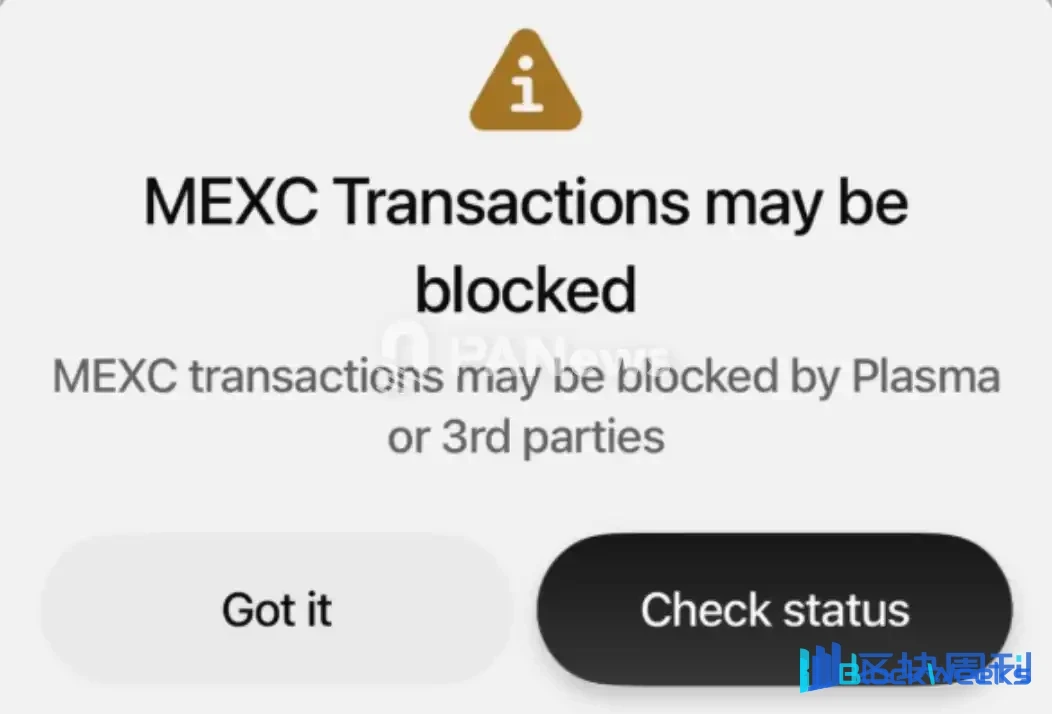
According to user feedback, Plasma has begun to warn that MEXC transactions may be restricted. In addition, Plasma's new version of the Terms of Service, effective November 6, also provides a clearer basis: Plasma explicitly prohibits users from transacting with wallet addresses, smart contracts, and protocols that are included in the U.S. OFAC SDN list, the UK sanctions list, CIMA-related lists, or flagged by its blockchain analysis and compliance partners.

It can be foreseen that as U.S. financial channel restrictions are gradually implemented, the pressure facing MEXC may no longer be limited to the U.S. market. What is truly worth watching is how many financial institutions and crypto infrastructure service providers will proactively draw boundaries in their funding dealings with it.
How did MEXC respond?
In an official statement, MEXC said it is reviewing the FinCEN order with its legal and compliance team, engaging in constructive communication with regulators, and has initiated an independent review of its anti-money laundering and sanctions controls; the platform also stated that operations are normal and user assets are safe.
From the broader industry background, this incident also carries a noteworthy signal: as stablecoins, crypto payments, and cross-border settlement gradually enter the traditional financial system, whether an exchange can continue to gain the trust of banks, payment institutions, and financial infrastructure is also becoming another important competitiveness factor for exchanges.