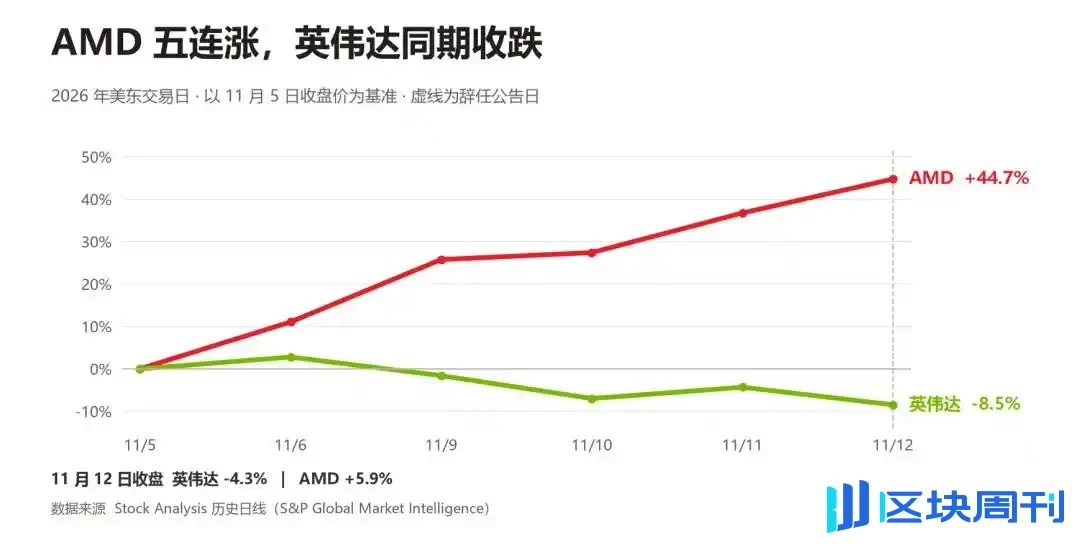
On November 12, Nvidia announced that Jensen Huang has resigned from his positions as President, CEO, and Director, effective immediately.After the U.S. stock market opened that day, Nvidia plunged more than 14% at one point, hitting a low of $148.8, down nearly 40% from its October high, with intraday market capitalization evaporating by more than $600 billion at one point.

Image source: Visual China
The founder's departure is the most direct trigger for this round of selling—the market is not merely responding to a single risk, but is repricing the entire company. At the same time, when an AI computing power leader's valuation has fallen to historic lows while demand remains strong, discussions about whether to buy the dip have also begun to heat up. And if one shifts attention away from this personnel change, one will find that the real questions Nvidia currently needs to answer may also include valuation, moat, and whether demand has already undergone irreversible changes.
The selloff triggered by Jensen Huang's resignation has pushed Nvidia's valuation to a rare position: about 12 times forward PE, the lowest level for this company's stock price in fifteen years. Over the same period, the S&P 500 index's expected price-to-earnings ratio is about 18 times. In other words, after a governance crisis, Nvidia's valuation has become cheaper than the broader U.S. stock market.
This valuation level corresponds to a business that remains strong. In fiscal year 2026 (ending January 2026), Nvidia's revenue was $215.9 billion, up 65% year over year, data center revenue reached $62.3 billion in a single quarter, and gross margin remained at around 75%. In the second quarter of fiscal year 2027, revenue was $96.2 billion, data center revenue was $89 billion, up 117% year over year, operating margin was 66.2%, and free cash flow reached $21.3 billion.
Although several investment banks lowered Nvidia's target price after the Jensen Huang incident, most still maintained Buy or Overweight ratings.
Barclays cut its target price from $275 to $210 while maintaining Overweight, explicitly stating that it "lowered the valuation multiple by about 25% to reflect reputation and transition risks in the coming months," with the current stock price implying about 20.9% potential upside. Goldman Sachs maintained Buy and cut its target price from $300 to $220; Citi cut from $285 to $225 while also maintaining Buy; Royal Bank of Canada cut from $330 to $230. Truist was one of the few institutions to directly downgrade the rating from "Buy" to "Hold," slashing its target price to $174, which happens to be near the current stock price.
Clearly, the institutional consensus is: the business is not broken, but the multiple assigned to the business needs to be reset. And the 12 times forward PE has already completed this reset to a considerable extent. The main support behind this comes from the fact that the long-term narrative on the demand side has not yet been disproven.
At the 2026 GTC conference, Jensen Huang predicted that by 2027, demand for AI chips in Blackwell and Rubin systems will reach at least $1 trillion, directly doubling the previous forecast of $500 billion for 2026. Anthropic's latest disclosed annual recurring revenue (ARR) is also still growing, and the total forecast for AI capital expenditure has not been revised down due to short-term fluctuations; only the slope of spending is shifting backward.
However, cheap valuation does not mean risk has disappeared. The risks Nvidia currently faces may be more fundamental than "who will be CEO."
First, the lock-in effect of CUDA is being eroded from the inference side.
The reason CUDA is a moat is mainly that the cost of migrating models from Nvidia GPUs to other chip architectures is relatively high. But Anthropic disclosed a landmark development during its IPO roadshow: its model Claude Mythos Preview, in just three days and with basically no human intervention, autonomously completed the migration of core GPU kernels, enabling Claude to run key inference steps on AMD's flagship GPUs.
Silicon Valley investor Marcelo P. Lima's comment has been widely cited: "Nvidia's CUDA moat no longer exists." This comment may be partly exaggerated, but the direction of the trend is clear: when large models themselves begin to have the ability to rewrite system software, the migration costs previously built at the expense of human engineering labor are being rapidly flattened by automation—CUDA will not collapse overnight, but the process of it changing from "everyone must use it" to "it is still needed on the training side, but can be omitted on the inference side" is already happening.
Second, the supply bottleneck Nvidia faces is not in wafers, but in HBM and packaging.
Industry data shows that TSMC can cut more than 400 million GPU dies a year, but Nvidia's actual annual deliveries are only about 10 million units. The real constraint is HBM: global annual HBM capacity is about 3.75EB, Nvidia can get about 70% of it, and each GPU requires an average of 260GB, which in total can only support about 10 million GPUs. At the same time, packaging capacity is also tight, and supply adjustments for HBM4 may delay the mass production pace of Rubin. This means that even if demand is unlimited, Nvidia's shipments are constrained in the medium term by a physical ceiling, rather than by its design capability or customer orders.
In addition, most importantly, what Jensen Huang leaves to Nvidia is not only organizational assets such as CUDA and architecture accumulation, but also three highly personalized things: strategic judgment on technology roadmaps, the ability to bargain with TSMC and SK Hynix in the supply chain, and direct communication channels with customers and the government. Interim CEO Colette Kress is a familiar face to the capital markets and has long served as CFO, but who will make the final call on Nvidia's product roadmap and who will maintain supply chain relationships—these questions have no answers before a formal successor is in place. This means that Nvidia's stock price after "de-Huang" is unlikely to collapse, but the premium the market was willing to pay for Jensen Huang will not automatically transfer to his successor.
Therefore, if opportunity and risk are viewed together, Nvidia's current position can perhaps be summarized in one sentence: the business is still there, but the "faith premium" assigned to the business is being systematically stripped away.
Admittedly, 12 times forward PE has already digested a considerable degree of pessimistic expectations. If the long-term direction of AI capital expenditure remains unchanged, demand for Blackwell and Rubin is realized, and the successor can stabilize supply chain and customer relationships, then the current price provides an entry window with decent odds. Barclays, Goldman Sachs, and Citi maintaining Buy ratings and giving more than 20% potential upside reflects exactly this judgment.
But "cheap" itself is still difficult to constitute a sufficient reason to buy. The loosening of CUDA's lock-in effect is a structural change that occurs slowly on a yearly basis but whose direction is difficult to reverse. The physical bottlenecks in HBM and packaging on the supply side limit the revenue ceiling Nvidia can deliver when demand explodes. And the uncertainty of the successor means that the stripping of the "founder premium" may not yet be over.
Bernstein said bluntly in its latest research report: "If you see two ants in the kitchen, the total number of ants in the kitchen is definitely more than two." It pointed out the chain that may develop next: from personal scandal, to governance vacuum and business news, to government investigation, each link will trigger a new round of selling. And the eruption of each link is bringing Nvidia's valuation one step closer from the "Jensen Huang premium" to the "ordinary semiconductor company premium."
Undoubtedly, what the market fears most has never been bad news, but not knowing when and in what form the bad news will appear. Before everything is settled, "how much is Nvidia worth without Jensen Huang" remains an open question.