Author: Zhou, ChainCatcher
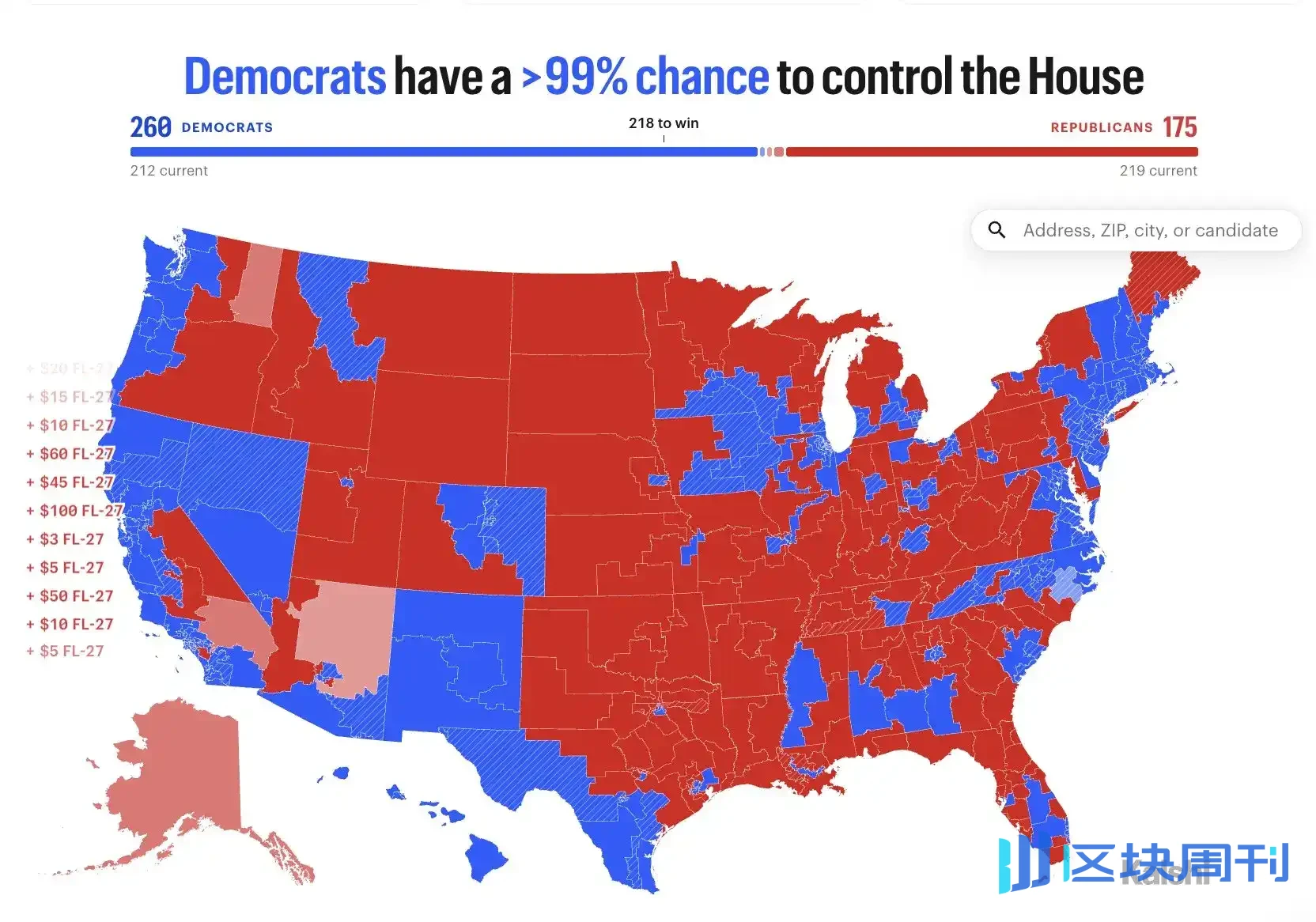
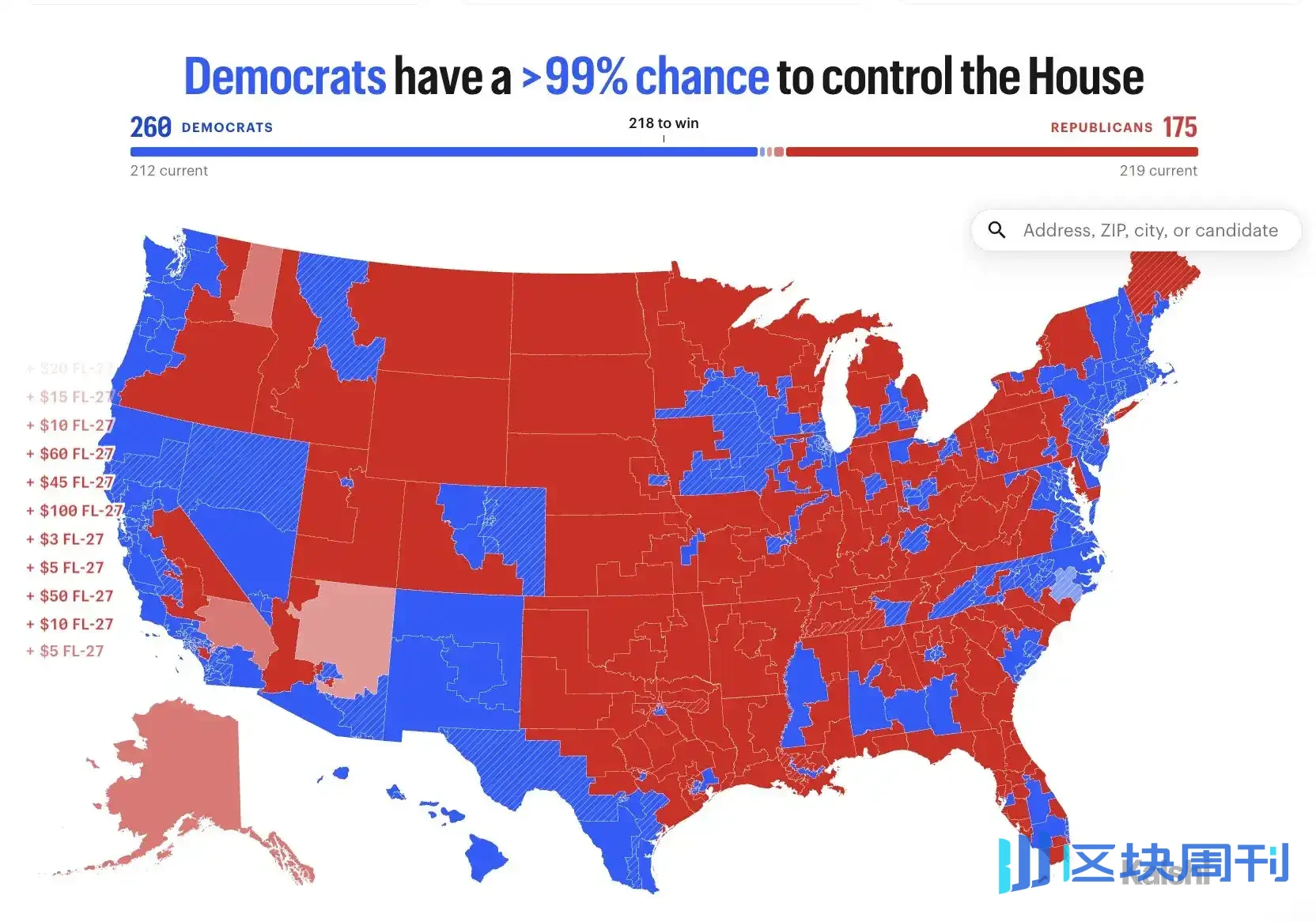
In the U.S. midterm elections on November 3, the Democratic Party swept both the Senate and the House of Representatives. Even before the results were officially announced, prediction market platforms Kalshi and Polymarket had already priced a Democratic sweep of both chambers as a high-probability event.
Kalshi officially stated that trading volume in midterm election-related markets exceeded $2.5 billion, roughly twice that of the entire 2024 election cycle. KalshiCEO said that the platform's favored candidates won 479 of the first 487 elections with results, a rate of about 98%.
For prediction markets, this should have been another highlight moment after the World Cup, but the prediction markets that correctly called the outcome quickly became a target of the winning side.
According to Politico, Democratic Senator Jeff Merkley, a long-time critic of prediction markets, said that with Democrats back in control of Congress, the time has come to push legislation to constrain this type of betting. Maxine Waters, who is competing for the chairmanship of the House Financial Services Committee, also pledged to crack down on predatory platforms, including prediction markets.
In fact, resistance to this industry began well before the election. From Apple to Hollywood studios, several companies have recently banned employees from betting using insider information; multiple states have already taken Kalshi to court, with lawsuits reaching all the way to the Supreme Court.
Why has this industry, which grew rapidly with the support of the Trump administration, become a target of public criticism in just two years?What will it mean for it now that Democrats have taken over Congress?
Prediction markets enter the hundred-billion era, while regulatory boundaries remain unresolved
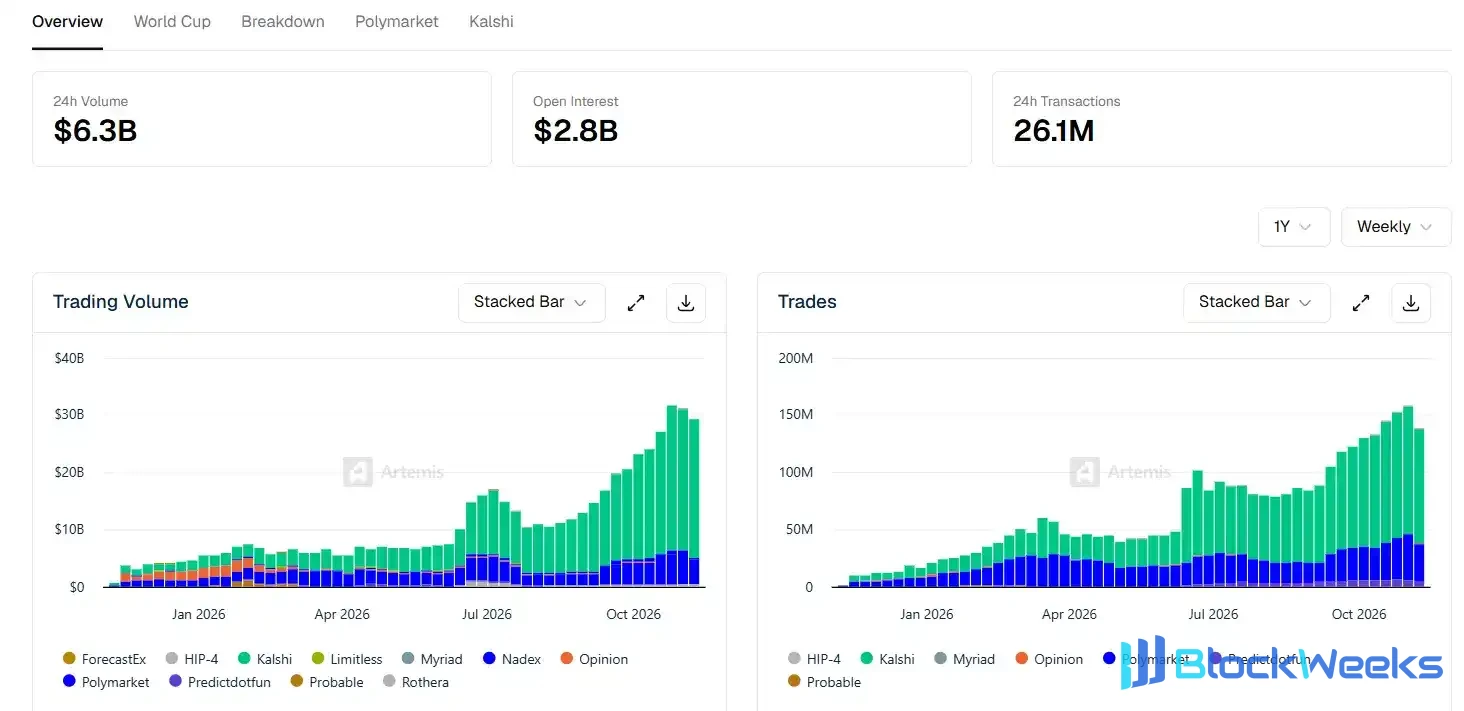
The expansion of prediction markets this year has been extremely rapid. According to Artemis data, industry-wide weekly trading volume was about $5 billion at the beginning of the year and had risen to more than $30 billion by the end of October. Full-month trading volume in October reached $123.3 billion, surpassing one hundred billion for the first time, with Kalshi accounting for about 80%.
Valuations have risen accordingly. On October 29, Kalshi announced it had completed a $1 billion financing at a $40 billion valuation, led by Sequoia Capital and Wellington Management.

According to a September 1 report by The Wall Street Journal, 1789 Capital, an investment firm where Donald Trump Jr. serves as a partner, plans to invest an additional approximately $300 million inPolymarket as part of a financing round of about $1 billion led by 1789 Capital; if completed, Polymarket's valuation would reach about $21 billion.
On the regulatory front, election contracts were still in a gray area in the United States two years ago. Kalshi did not obtain approval to launch related markets through litigation until the fall of 2024, while Polymarket was barred from serving U.S. users due to a 2022 settlement with the CFTC.
After the Trump administration took office, the wind changed. Regulators have generally taken a supportive stance toward prediction markets, clearing obstacles for their expansion into areas such as politics, sports, and stocks. Polymarket also returned to the U.S. market through a subsidiary holding a CFTC license.
At present, prediction markets are regulated at the federal level by the CFTC. Both Kalshi and Polymarket's U.S. site operate as CFTC-designated contract markets, and platforms can self-certify new contracts to the CFTC when launching them without prior approval. Polymarket's main overseas site is not subject to U.S. regulation and, under the 2022 settlement agreement, may not be opened to U.S. users.
At the state level, sports betting is governed by state law. The disagreement between the two sides is whether sports event contracts are financial derivatives under the CFTC's exclusive jurisdiction or betting activities that should be subject to state law. To date, federal courts have not settled the matter, and at least 15 states have proposed legislation related to prediction markets.
However, of the CFTC's five commissioner seats, currently only Chairman Michael Selig is in office. According to CNBC, some lawmakers are concerned about whether the agency, which has just undergone layoffs, can cope with a rapidly expanding market.
Insider trading and disguised gambling: the costs of growth begin to emerge
As trading scale continues to expand, two types of problems have gradually surfaced.
The first is insider trading. Prediction markets allow betting on almost any event, and people with inside information naturally have an advantage, while weak regulation makes it easy to cash in on that advantage.
The most emblematic case occurred in April this year. The U.S. Department of Justice sued Army Special Forces Sergeant Major Gannon Ken Van Dyke, accusing him of participating in planning the January operation to capture Venezuelan President Nicolás Maduro and using classified information to bet about $33,000 on Polymarket, making more than $400,000 in profit. This was the first time the Justice Department brought criminal insider trading charges related to prediction markets.
Similar suspicious trades are not isolated cases. Statistics from the U.S. research organization Anti-Corruption Data Collective ACDC reveal the structural reasons behind this. In Polymarket's overseas congressional election markets, the top 1% of wallets contributed about 70% of trading volume, and 80% of markets had fewer than 100 participating wallets. As more and more markets are created, individual markets become thinner and thinner, and a small number of informed people are enough to sway prices.

The second is disguised gambling. Kalshi, relying on its CFTC license, still offers sports event contracts in many states that have not yet opened sports betting. States argue that this is using the name of financial derivatives to circumvent state law regulation and the corresponding taxes.
Ordinary users have paid the price for this. Galaxy Research analyst Will Owens studied about 2.9 million accounts on Polymarket's overseas site that traded at a human pace, and found that 69.2% ultimately lost money, with total losses of about $339 million. The profit rate among traders focused on sports was only 25.1%, the lowest among all sectors; traders focused on technology and science had the highest profit rate, and the report believes some of them may possess inside information.

Owens also pointed out that the two platforms spent heavily on marketing and attracted exactly the group with the worst profit performance. According to Front Office Sports, Polymarket pays LeBron James $15 million a year to promote football-related prediction markets.
The two types of problems point to the same result. In this market, returns flow to the minority with more information, while risk falls on ordinary players drawn in by marketing.
Unable to wait for legislation, all parties have already cast opposing votes
As problems continued to accumulate, opposition from all sides emerged even before the election. The first to speak out was the public. A poll released by Reuters and Ipsos in October showed that most American respondents believe that betting on real-world events in prediction markets is gambling, and more than 60% oppose betting on election outcomes.
Within the government, on October 20, U.S. Secretary of Defense Pete Hegseth signed a memorandum prohibiting Department of Defense personnel from betting using classified or unclassified non-public information, and named Kalshi and Polymarket in the text. He warned that adversaries are also watching movements in these markets. This ban came from within the Trump administration, which has consistently supported prediction markets, making its weight especially significant. Around the election, Apple and Hollywood studios also successively issued similar bans to their employees.
The strongest opposition came from the states. The Utah attorney general filed felony charges against Kalshi and its two co-founders, Oregon sued Kalshi and sought back taxes, and a federal judge in California approved a tribe's application to prohibit Kalshi from offering sports contracts on the plaintiff tribe's land.
The lawsuits between the states and Kalshi ultimately reached the Supreme Court. In April of this year, the Third Circuit Court of Appeals ruled that the CFTC has exclusive jurisdiction over sports contracts, siding with Kalshi; in August, the Ninth Circuit Court of Appeals issued the opposite ruling in a Nevada case. On September 2, New Jersey accordingly applied to the Supreme Court for a writ of certiorari.
Supreme Court filings show that 11 amicus briefs have been submitted in support of New Jersey, including from 39 states led by Ohio and the District of Columbia, 145 Indian tribes and tribal organizations, the NFL, and former CFTC Chairman Gary Gensler and former Senator Christopher Dodd. Among them, Dodd was one of the proposers of the 2010 Dodd-Frank Act, a law that greatly expanded the CFTC's regulatory authority over derivatives.
Democratic election victory increases pressure, but the real variable is the Supreme Court
This Democratic election victory has added another force from Congress to this encirclement. But in fact, congressional scrutiny of prediction markets had already begun when Republicans controlled Congress.
In May of this year, House Oversight Committee Chairman and Republican James Comer launched an investigation into insider trading in prediction markets, requiring Polymarket and Kalshi to explain how they identify abnormal trading.
After the Democrats take over, this kind of oversight will only intensify, and it will carry an additional layer of political motivation. Donald Trump Jr., the eldest son of Trump, simultaneously serves as an adviser to both Kalshi and Polymarket, and the investment firm where he works, 1789 Capital, has also invested in Polymarket. Politico believes that Democratic scrutiny of prediction markets may become a window for observing how they deal with companies affiliated with the Trump family.
However, turning oversight into legislation is not easy. The bill proposed by Merkley and Representative Jamie Raskin in March of this year would prohibit betting on events such as elections, sports, war, and government actions. Even if such a bill passes both chambers, Trump can still use his veto power.
Aaron Klein, a senior fellow at the Brookings Institution, believes that the hard constraints of legislation are often overestimated, while the soft constraints of hearings and investigations are often underestimated. Congress has no power to remove Selig, but it can exert pressure through hearings and can also attach provisions to appropriations bills to restrict the CFTC from using funds for litigation or drafting new rules.
These soft constraints matter because the CFTC's own position is not monolithic. On the one hand, it has sued 10 states, including Utah and Kentucky, to defend its exclusive jurisdiction over sports contracts.
On the other hand, it filed a civil lawsuit against Van Dyke and, according to Reuters, is also reinvestigating whether Polymarket violated the 2022 settlement agreement not to open its overseas main platform to U.S. users. What the CFTC is truly defending is federal jurisdiction and the licensed operating model.
Once Congress restricts the CFTC's funds for litigation, it may also lose the confidence to confront the states. If the Supreme Court accepts New Jersey's case and sides with the states, the logic of federal jurisdiction on which Kalshi relies to expand across the United States will be directly shaken.
Kalshi was originally scheduled to submit its response on November 9, and the Supreme Court has approved an extension to December 7. At this pace, the Supreme Court will not decide whether to accept the case until early next year at the earliest.
Will prediction markets become the next crypto industry?
Politico, citing a former Wall Street regulatory official, said that on the Democratic congressional agenda, prediction markets may become the new crypto industry.
The crypto industry also once expanded rapidly in an environment lacking rules, and then was repeatedly pulled back and forth between enforcement pressure and legislative battles.
Now prediction markets have reached a similar crossroads. Growth continues, the costs have already appeared, and the encirclement has extended from companies and states to Congress and the Supreme Court.
For an industry that can predict elections, what may be harder to predict is its own regulatory outcome.