


Large investors have woken up in the Ethereum memecoin market. Two wallets that had shown no signs of life for months synchronously transferred 2.27 trillion PEPE tokens worth $10.19 million. Their maneuvers brought traders' attention back to the network's main speculative assets — PEPE and Shiba Inu (SHIB).
However, instead of the expected collapse in prices, the market responded with a sharp price jump that brought the capitalizations of the two projects right up close to each other.
Capital came into motion after a long pause. The first address, which had been dormant for a year and was previously used for deposits to Coinbase, moved tokens worth $6.53 million. The second wallet broke a four-month silence with a $3.66 million transaction. Usually, the movement of old coins means that investors are preparing to take profits on an exchange.
But this time, buyers ignored the risk: 84% of the entire twelve-hour trading volume came in the last six hours — the whales' supply was simply fully bought up from the market within a few hours.
Rivalry worth billions: PEPE is hot on SHIB's heels
Against this backdrop, PEPE's daily growth on TradingView charts exceeded 10.8%. The momentum immediately spread to Shiba Inu (SHIB), which gained 1.66%, consolidating its position after a successful September. The current activity has completely rewritten the balance of power in the sector: the market capitalization gap between Shiba Inu and PEPE has narrowed to a historic low of $1.06 billion.
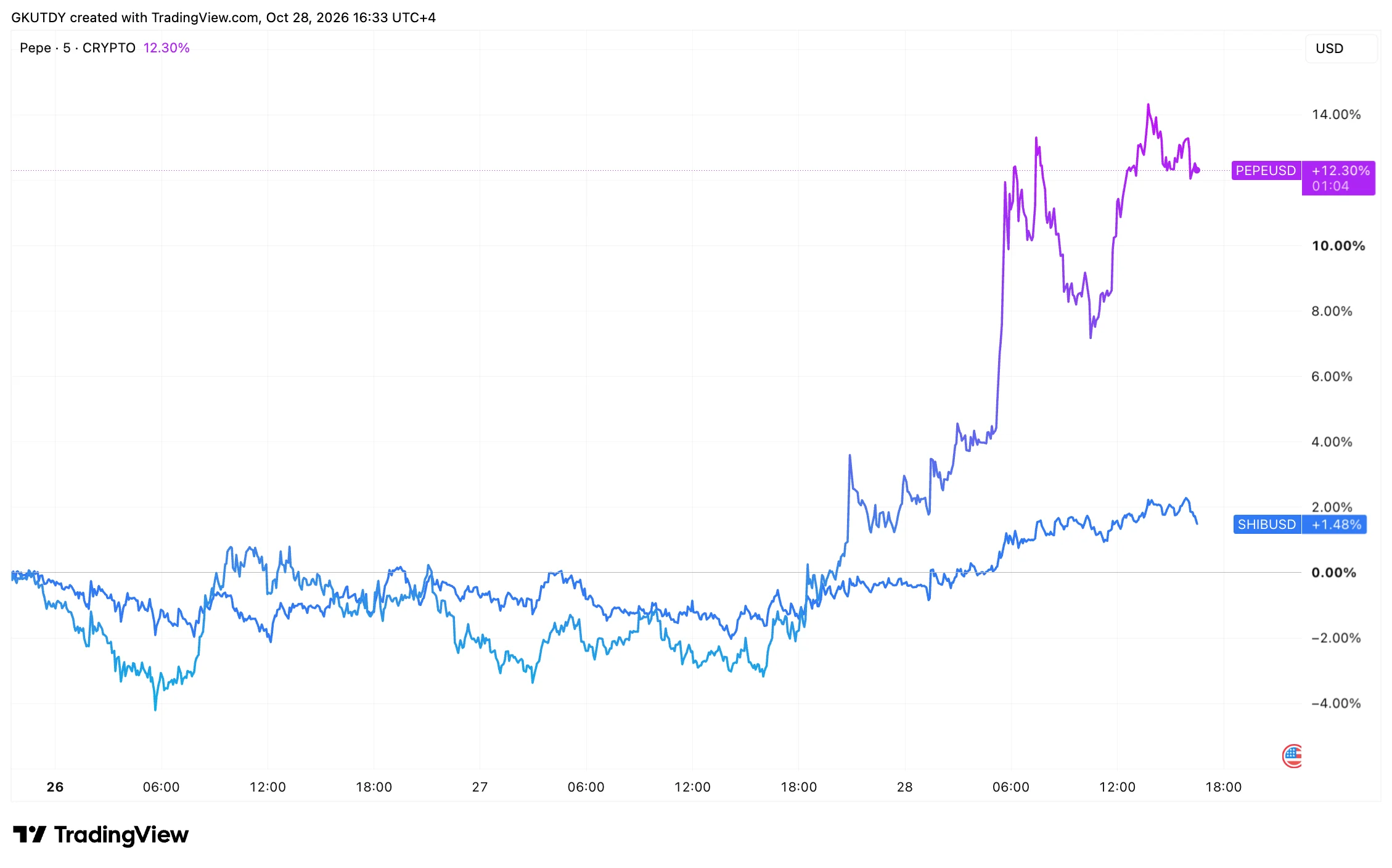
Memecoins are once again intercepting speculative liquidity from the rest of the crypto market, and the battle between the two main coins is becoming the main driver across the entire Ethereum network.
The main risk of this rally is the extreme concentration of coins in the same hands, the scale of which is also confirmed by fresh data from Arkham Intelligence. It turned out that in parallel with the maneuvers of the awakened whales, Tron founder Justin Sun was aggressively building up his position, having accumulated 2.82% of the entire PEPE supply ($51.25 million) over the past ten days.
In conditions where large holders still control up to 94.66% of the PEPE supply, and the fate of a multimillion-dollar sector depends literally on two dozen wallets, the actions of the largest players have already shifted the balance of power and reduced the market distance between the industry leaders.