



According to the latest report by Cryptorank, tokenized real-world assets (RWAs) are connecting traditional financial instruments with blockchain-based markets, allowing eligible investors to hold tokenized fund shares, commodity exposure and equity-linked products in digital wallets.
Tokenized U.S. Treasury funds remain the largest individual asset category, with $14.7 billion in value, representing approximately 37% of the $39.3 billion distributed RWA market.
These products give eligible investors exposure to Treasury portfolios through fund tokens, with subscription, redemption and transfer conditions determining how capital can be accessed.
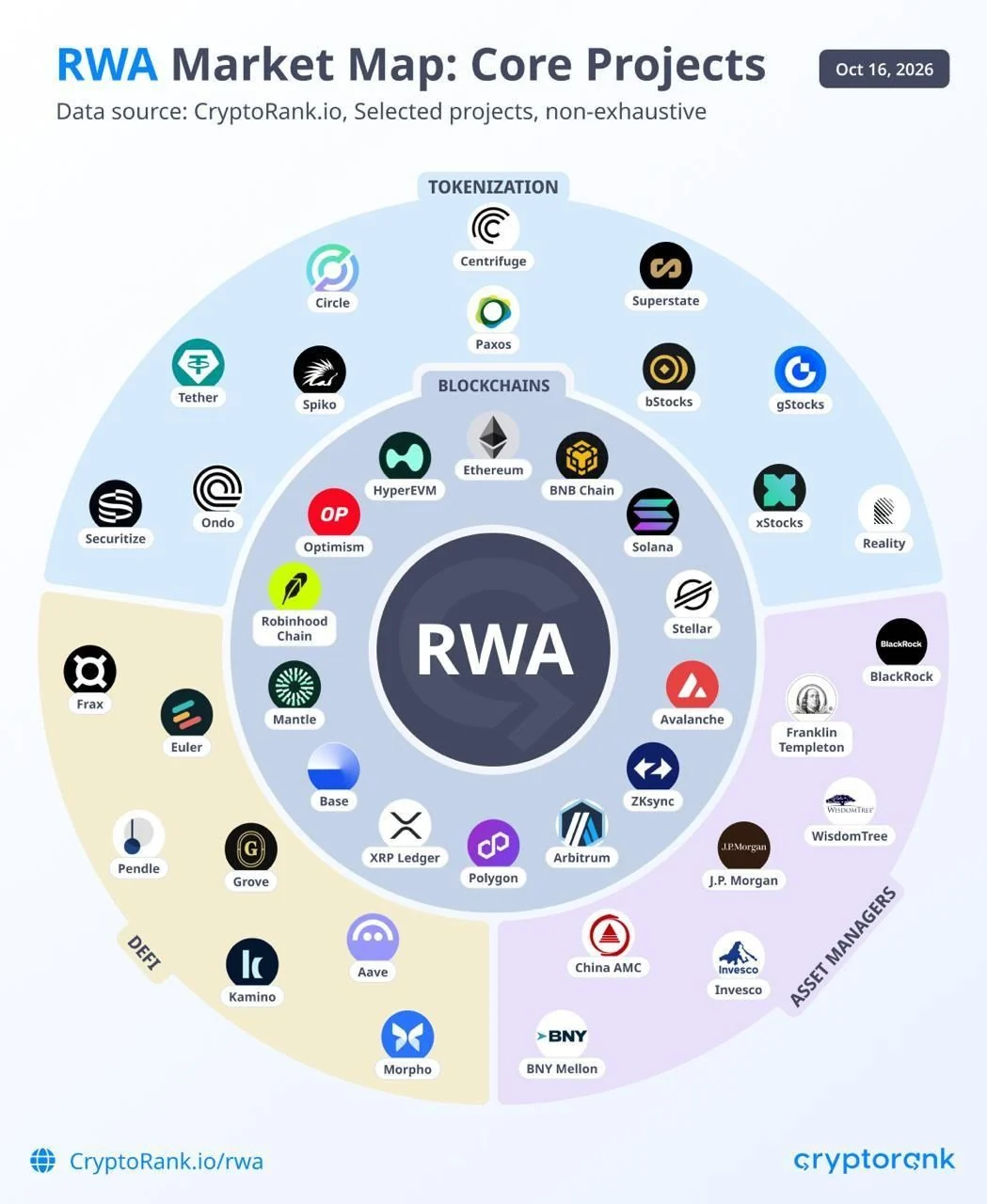
Commodities have also expanded. Their tokenized market capitalization increased from $3.1 billion at the end of 2025 to approximately $8 billion by late September 2026, roughly 2.6 times the starting value. Ethereum holds the largest share of this market, while XRP Ledger accounts for another substantial portion.
Gold accounts for most tokenized commodity value. Tether Gold and PAX Gold link their tokens to vaulted gold, while products such as Kinesis Silver provide exposure to allocated silver bullion. Redemption and physical delivery depend on each issuer's terms.
The increase in tokenized gold value reflects both higher metal holdings and price appreciation. The amount of gold held through these products rose 73% in the year to Aug. 31, 2026, while the gold price increased 29% over the same period.
Tokenized ETFs have also grown. Their combined value increased from $225 million at the end of 2025 to $673 million by the end of the third quarter of 2026, nearly tripling.
The third quarter alone recorded growth of approximately 59% from a $422 million starting value. Ethereum remained the largest market, while BNB Chain accounted for a growing share.
Tokenized stocks have attracted more than 4.3 million holder positions across company-linked products. However, the number of holders does not necessarily indicate the amount invested or the level of ongoing activity. Multiple wallets may belong to the same investor, while custodial addresses can represent many customers.
The legal structure also matters. Some products, including xStocks, are structured as tracker certificates backed by underlying assets.
They can provide economic exposure without granting shareholder voting rights, meaning the rights attached to a token may differ from those associated with directly holding a company's shares.
Derivatives outpace spot trading as DeFi lending lags
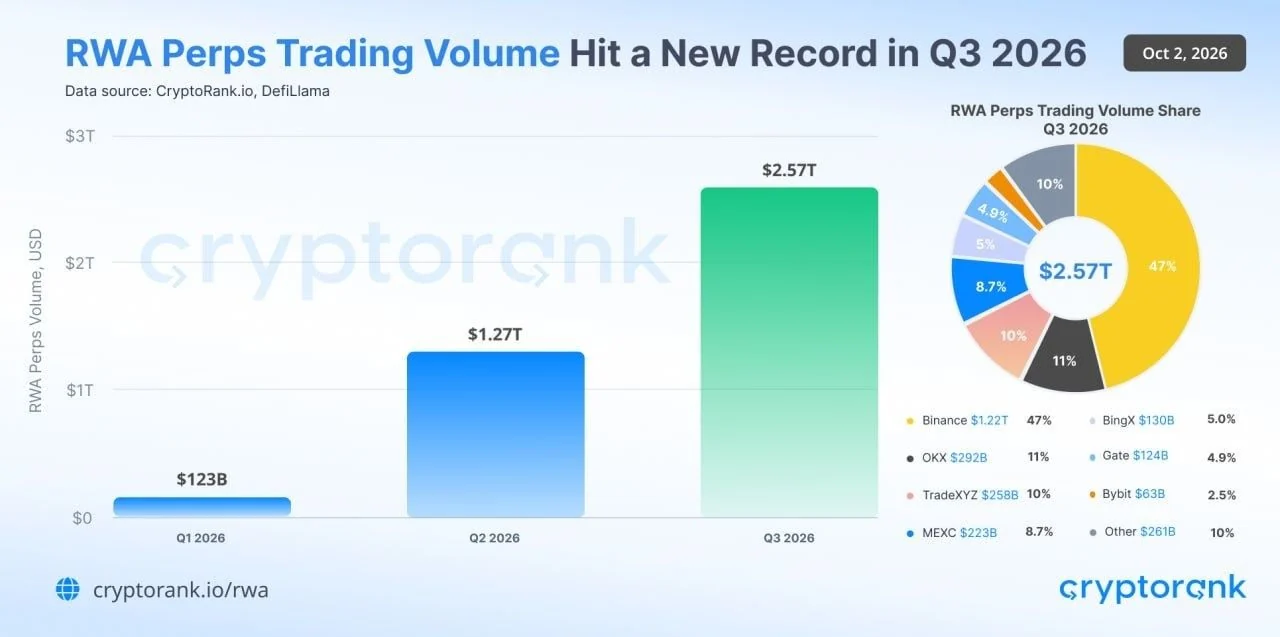
RWA perpetual trading volume reached $2.57 trillion in the third quarter of 2026, more than double the $1.27 trillion recorded in the second quarter. Binance accounted for nearly half of the quarterly total, with activity spanning centralized exchanges and decentralized venues.
Separate figures for August show that equities accounted for 8% of tracked tokenized asset value but 93% of onchain spot trading volume. Equity perpetuals recorded $72.4 billion in volume, compared with $12.6 billion in spot trading, nearly six times as much.
The figures illustrate the distinction between holding tokenized assets and trading contracts linked to their prices. Perpetuals allow traders to take long or short exposure without owning the underlying asset, and leverage can make trading volume substantially larger than the collateral committed.
Trading outside conventional stock-market hours introduces additional risks. Crypto venues can continue matching orders while the underlying equity markets used for hedging are closed.
During those periods, thin order books and reliance on available price feeds can affect execution quality.
The use of tokenized assets as collateral in decentralized finance remains more limited than their availability might suggest. Approximately 42% of stock-token supply is eligible to serve as DeFi collateral, but only about 2.6% is actually deposited in lending markets.
Tokenized credit has a higher lending participation rate, with approximately 19% to 21% of its supply deposited in lending protocols. By comparison, the figure for cash-equivalent products is around 0.4%.
These differences reflect the distinct roles of the products. Credit tokens can support borrowing strategies, while Treasury-backed cash equivalents are often held to earn income. Eligibility alone does not guarantee demand for borrowing or lending.
Redemption conditions are another constraint. Some tokenized investment products offer standard redemptions based on their strategies' valuation and settlement schedules, while faster withdrawals may depend on dedicated liquidity and incur additional fees.
Lenders must account for those limitations when deciding how much to advance against a token.
RWA companies also continue to raise capital for the infrastructure supporting the market. Disclosed venture rounds totaled $237.5 million across 26 deals in the first nine months of 2026. Superstate's $82.5 million Series B represented approximately 35% of that total.
The broader trend suggests that tokenized assets are gaining traction in investment holdings and trading. However, expanding their role in decentralized lending will require more than blockchain issuance.
Reliable pricing, sufficient liquidity, workable redemption mechanisms and a dependable route to liquidate collateral remain essential to broader adoption.