


Author: Alea Research
Compiled by: Shenchao TechFlow
Shenchao Introduction: Polygon is undergoing a critical tokenomics transition from a single scaling solution to a payment settlement foundation. By acquiring Coinme to obtain money transmitter licenses in 48 U.S. states, combined with an on-chain high-frequency stablecoin payment network, Polygon's base fee revenue has exceeded the current token inflation minting volume for several months. Based on detailed on-chain micro data, this article deeply calculates its fee capture model and staker revenue-sharing mechanism, revealing its current significant valuation gap relative to public chain leaders.
Key Takeaways
In 2025, the base network fees paid by users on the Polygon chain were only equivalent to 5% of the newly minted POL tokens that year. However, from January to September 2026, this ratio directly climbed to 86%. In 5 separate months throughout the year, the burned base fees even completely exceeded the new minting volume for that month.
Polygon Labs has now established a complete payment loop from USD fiat on/off-ramps to final on-chain settlement. Its acquisition of Coinme directly brought the ecosystem money transmitter licenses covering 48 U.S. states.
As of September 2026, the Polygon chain firmly holds the throne as the busiest stablecoin settlement network across the entire network, processing an average of 17.6 million stablecoin transfers per day, accounting for one-third of the total stablecoin payment transactions across the nine major public chains.
Over the past 18 months, Polygon's median transfer fee per transaction has increased fivefold, but the number of on-chain transfer transactions has simultaneously exploded by 7.5 times, demonstrating extremely strong rigid payment demand and fee tolerance.
Currently, POL's trading multiple is less than half of TRX's. On September 30, POL's price-to-earnings valuation based on the past 12 months of on-chain fees was 41.2 times, while TRX's valuation during the same period was as high as 87.5 times.
The dedicated base fee reserve pool for burning is now almost on par with newly minted POL, and stakers directly receive half of the validator fund pool through the PIP-85 proposal.
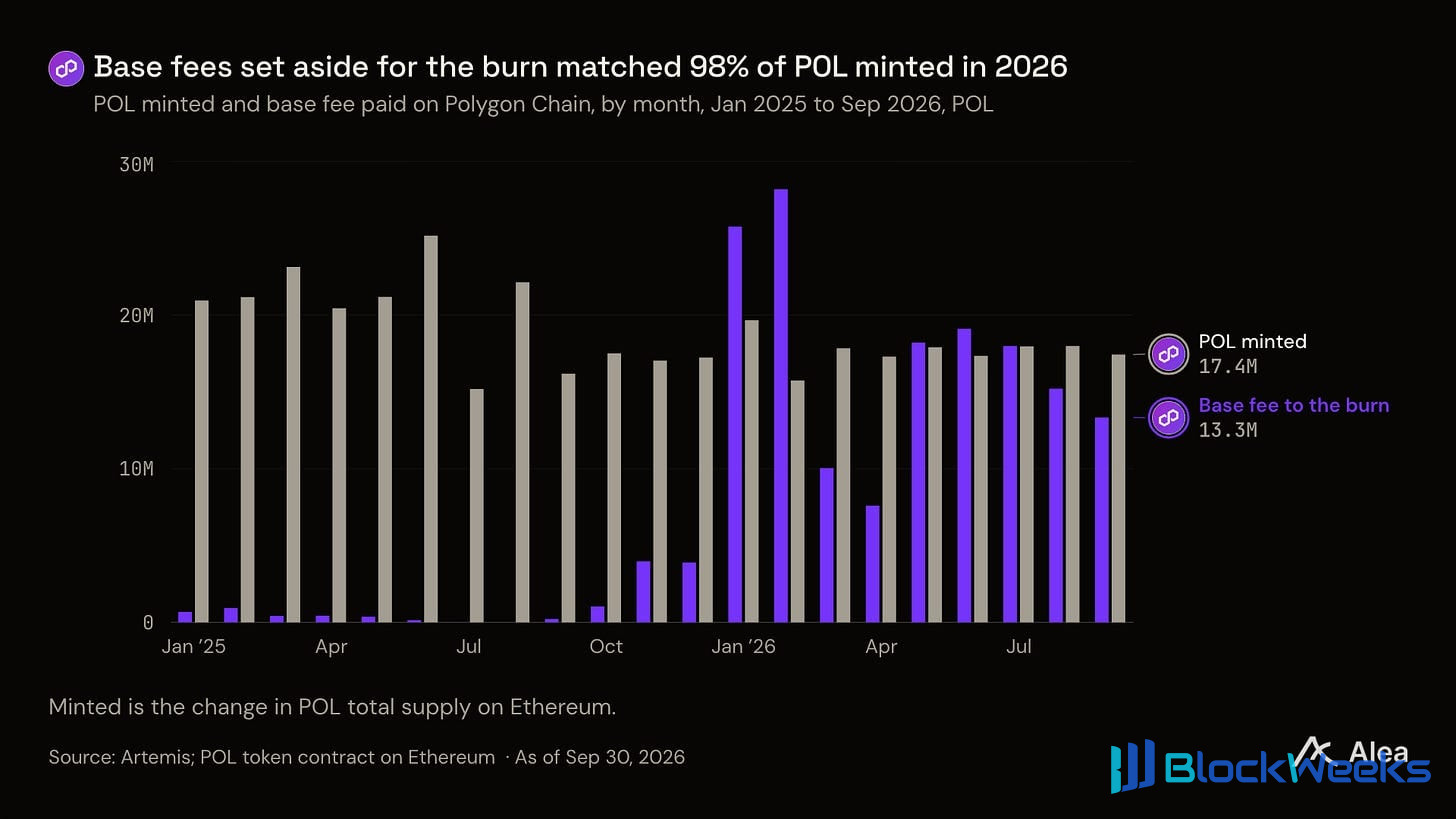
Figure: Overview of Polygon on-chain stablecoin transfers and gas fee capture
Securing the Underlying Infrastructure for U.S. Fiat On/Off-Ramps
Polygon Labs officially completed its full acquisition of crypto payment service provider Coinme on October 14. This blockbuster deal directly injected the team with money transmitter license assets covering 48 U.S. states.
Around this closing milestone, the development team launched 5 major iterations in just 30 days: an institutional-grade subscription service based on Polygon ID, a gas-free experience relay network, and a dedicated matching channel for large transactions.
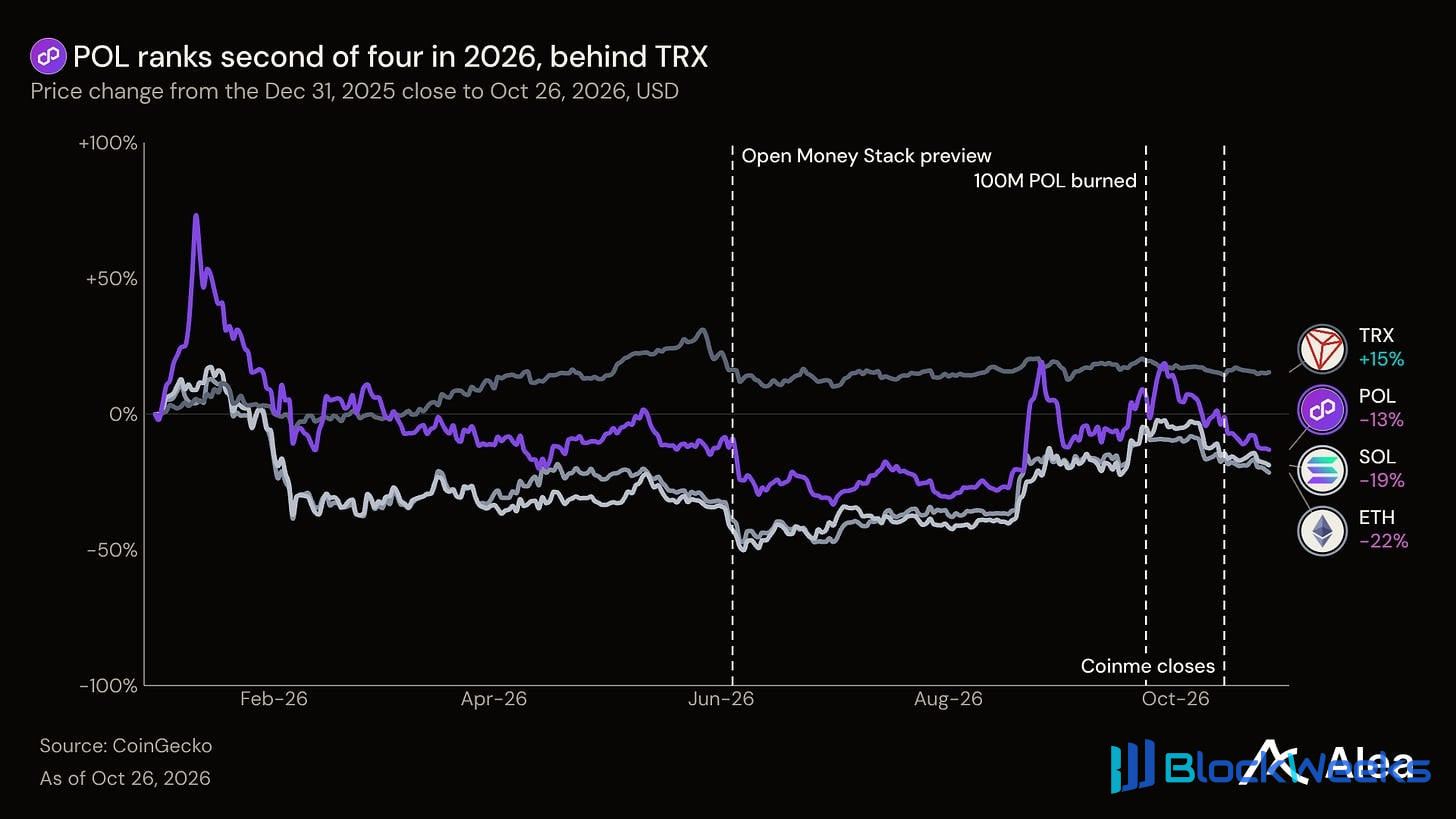
Figure: Comparison of price trends and drawdowns of major public chain assets during the year
The entire technology stack adopts a fully open design architecture. When TRON announced its integration on October 8, Polygon explicitly stated that its goal was precisely to more smoothly capture the $94 billion USDT assets already circulating on the TRON network.
The Most Active Retail Stablecoin Payment Hub Across the Network
From January to September this year, no public chain could match Polygon's average daily stablecoin transaction frequency, with its average daily stablecoin transfer count firmly ranking among the top across the entire network.

Figure: Polygon staking rewards and PIP-85 implementation roadmap
The vast majority of these transfers are typical small-amount daily payments. In the third quarter, the average transfer amount per transaction on the Polygon chain was $175, while during the same period, the average transfer amount on Solana was as high as $1,254, and on Ethereum mainnet it was even higher at $3,850.
Even though the per-transaction fee has risen somewhat from earlier low levels along with network activity, the median stablecoin transaction cost on the Polygon chain in Q3 was still only 1.6 cents, enabling global cross-border merchants and remittance applications to maintain extremely high settlement profit margins.

Figure: Trends in average daily stablecoin transfer counts across major public chains
Stablecoins Contributed 72% of the Network's Gas Consumption
On the Polygon chain, every interaction must pay a base gas fee in POL. In the first 9 months of 2026, gas fees driven purely by stablecoin transfers accounted for as high as 72% of the chain's total revenue.

图:各公链每千笔稳定币交易所消耗的交易费用对比
若从单位美元资产周转的创收效率来看,Polygon 每流转一美元稳定币所捕获的链上费用,已经实质性超越了 Solana、Ethereum 与 Base,仅次于波场网络。
基础费销毁机制逼近通胀新增铸造
按照 Polygon 现行设计架构,每笔交互产生的基础费用直接划入销毁收集器储备池,而优先费用则全部定向分配给区块验证节点与质押者。

图:Polygon 链上稳定币与非稳定币交易的费用贡献比例
伴随 PIP-85 提案正式落地,普通质押者能够扣除佣金后直接分得验证者资金池中整整一半的优先费分成,有效锁定了大量链上原生流动性。

图:Polygon 历史五期销毁执行与储备走势
相对估值倍数严重落后于波场
1 月 1 日时,POL 的动态市盈率倍数曾高达 179.6 倍,而 TRX 为 45.8 倍。但随着 Polygon 链上实际结算收入与销毁体量爆发式增长,截至 10 月底,POL 对应过去 12 个月真实链上费用的市盈率估值已压降至 30 倍附近,市值约 $9.49 亿,对应年化费用规模达 $3160 万。

图:POL 与 TRX 过去一年费用乘数走势变化
对比波场网络 40 倍以上的估值中枢,市场资金对 Polygon 支付基本面的重定价显然仍处于严重滞后区间。当支付公司与机构全面采纳固定费率时,真实的代币净通缩窗口将彻底显现。