Musk's AI assistant has also started hiring Claude to do the work!
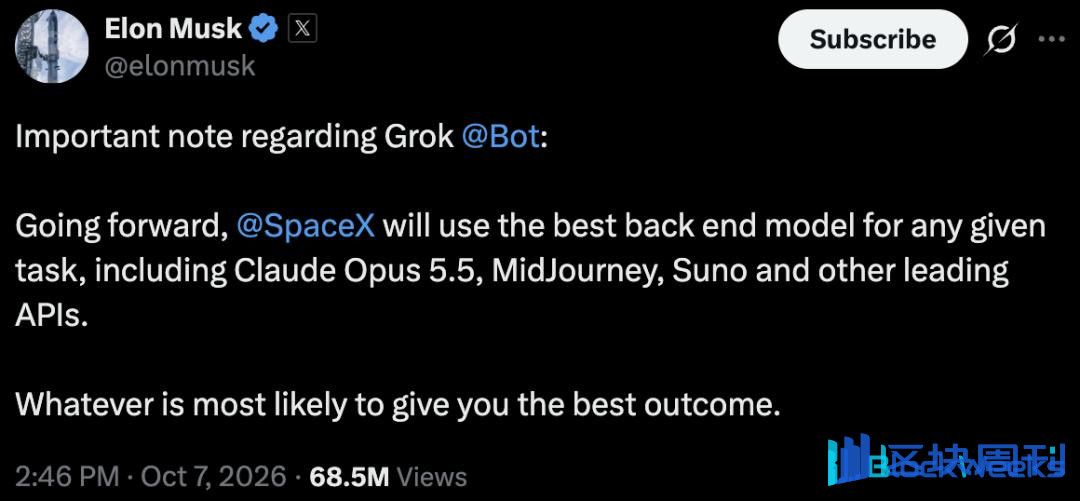
On October 7, Musk announced on X that Grok Bot will select the most suitable backend model based on the specific task, and directly named Claude Opus 5.5, Midjourney, and Suno.
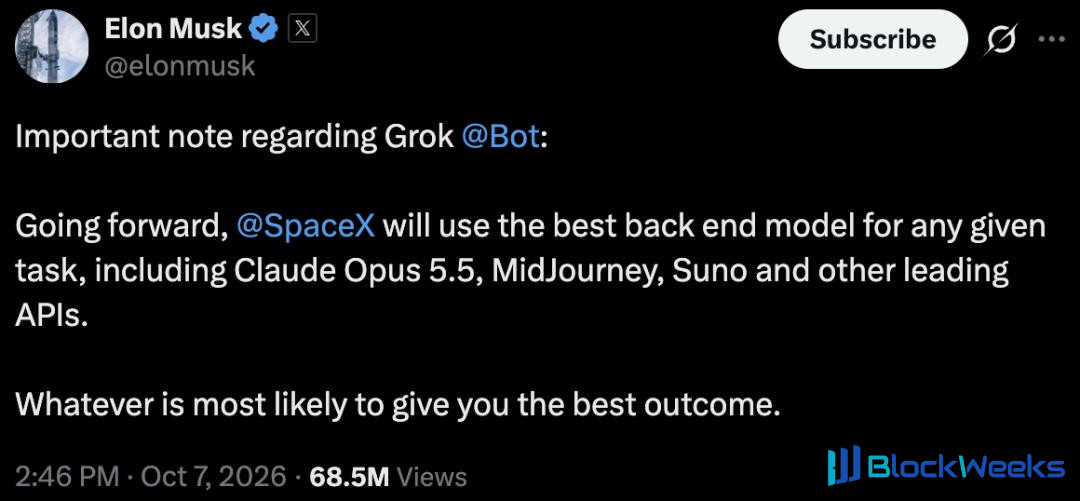
The standard he gave was simple and direct:
Whichever is most likely to bring you the best result, use that one.
Whoever works well, use them.
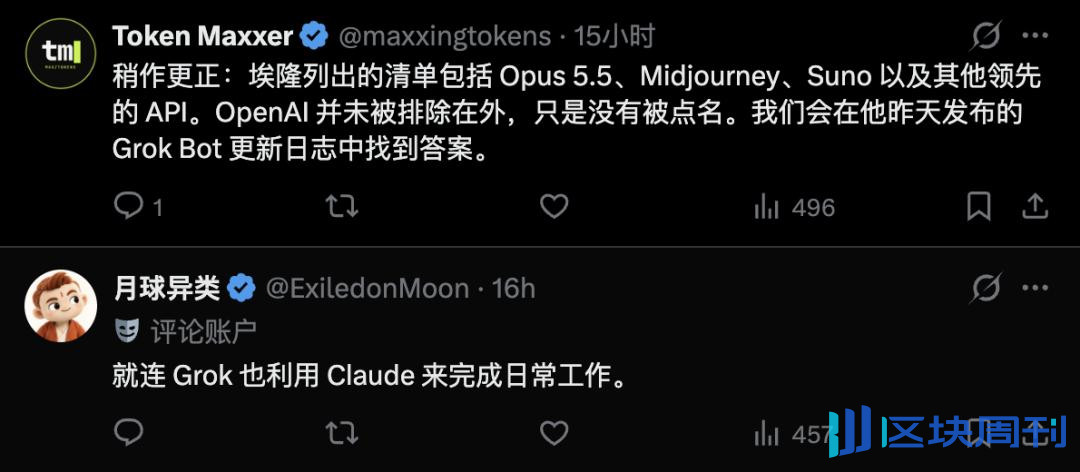
Netizen ExiledonMoon joked that even Musk's AI assistant has started asking Claude for help with the work.
Another netizen, Token Maxxer, reminded: the list Musk gave also includes "other leading APIs." OpenAI was simply not named, and was not explicitly excluded.
This also leaves a suspense: will OpenAI's models also become outside reinforcements for Grok Bot?
At least, Claude has already started on the job.
According to a same-day report by 9to5Mac, Grok Bot can already use Claude Opus 5.5.
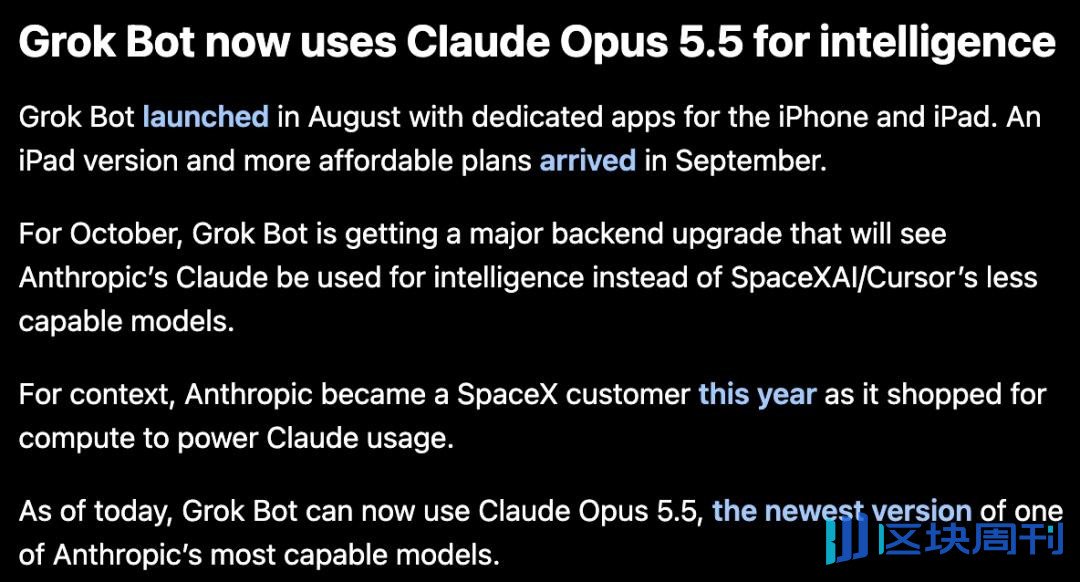
You hand the task to Musk's AI assistant, and the one doing the work behind the scenes may be Claude.
While competing with Anthropic for users, he is also calling Claude. Why is Musk willing to do this?
Borrowing a rival's model to win over its own users
Judging from the "best result" that Musk emphasized, his thinking is very practical:
First let Grok Bot do the user's work well; there is no need for its own model to handle every part.
If a certain task can be done better with Claude, then integrating it may help reduce the chances of users turning to other products because of a poor experience.
More critically, even if the one doing the work behind the scenes is Claude, the place where users state their needs, connect tools, and follow up on tasks can still be Grok Bot.
Anthropic provides part of the model capability, while Grok Bot is responsible for organizing these capabilities and delivering the results. As long as the task is completed well, users have a reason to keep using this assistant.
Therefore, calling a rival's model can also become a means of winning users.
Even if part of the work is completed by Claude, the next time users have a task, they may still open Grok Bot first.
What Grok Bot wants to take on is the whole thing
The Grok Bot mentioned by Musk this time launched its Beta version on August 11.
This intelligent assistant comes with a cloud computer, on which it can execute tasks for users.
According to the official introduction, Bot can use tools, log into applications, and handle work across software; multiple Bots can also communicate with each other, share task context, and divide work and collaborate.
After the user leaves the computer, the work can continue.

Multiple Grok Bots hand over tasks and report progress.
Musk mentioning Grok Bot this time does not mean that the Grok chat function on X will also fully switch to Claude.
Besides Claude, the list also includes the image generation tool Midjourney and the music generation tool Suno, spanning text, images, and music, corresponding to a very practical need: completing a whole thing often requires several capabilities working together.
For example, to make a short video, you need to write the script, prepare the cover, and also add a piece of music.
Ask a few AIs for help, and the materials may be ready very quickly. But explaining the requirements, moving files, and coordinating revisions often still require you to go back and forth between different windows.
If Grok Bot can call the appropriate model according to the task and connect these steps, it has a chance to take over part of the coordination work for you.
What users want is very simple: switch back and forth less among several models and tools, and not have to explain the same need several times.
It even wants to save you from choosing which model to use
The more models it connects to, will it instead give users "choice difficulty"?
Opening an assistant, you still have to think it through first: should I use Claude or Grok for writing code? And which tool should I switch to for making images?
Grok Bot's official documentation has already laid out the design approach:
Model selection is managed by the platform, there is no user-facing model selection menu, and the actual combination of models used may change over time.
In other words, you assign the task, and the system picks the model for you.
You don't have to research who upgraded recently just to write a piece of code; nor do you have to comb through the capability lists of various tools just to make an image.
However, this doesn't mean users don't need to know what was used and how much was spent.
The official documentation mentions that usage analytics will show which model was actually used, and costs are calculated based on the model used.
This information can help users understand where their money goes and judge whether the task was worth it.
Is letting AI choose models really reliable?
After handing the choice to the system, the question arises: what advantages does letting AI pick models for people have, and is such a choice reliable?
Having one model assign work to other models already has precedents.
As early as 2023, HuggingGPT attempted to have ChatGPT break down user tasks, select suitable models based on model descriptions on Hugging Face, and then have the system call these models to execute tasks and aggregate results.
OpenAI's recently opened public beta Decisions API also provides a tool for this kind of selection.

Developers provide task information and candidate options, GPT-6 Luna returns a judgment, and then the application executes the next step based on that judgment.
Used in a multi-model assistant, it can help decide: which model should the current task be handed to.
The advantage of automatic selection is especially evident when a task requires repeatedly calling models.
Simple information organization, complex reasoning, and final text polishing have different requirements for model capabilities. If the system can judge step by step, it has the opportunity to use stronger, more expensive models only in the stages that truly need them.
This kind of approach has already been validated by research for its cost benefits.
The 2024 RouteLLM study showed that in the MT-Bench evaluation, by distributing requests between GPT-4 and Mixtral, the system could achieve about 95% of GPT-4's evaluation performance while reducing costs by more than 85% compared to using GPT-4 entirely.

RouteLLM's model allocation performance in MT-Bench.
But this result compares automatic allocation with fixed use of GPT-4; it cannot fully prove that AI is better at choosing models than humans, nor can it be equated with Grok Bot's actual test results. How Grok Bot specifically chooses models still requires more public information to judge.
Moreover, "suitable" has no answer that applies to everyone.
Some people are in a hurry, some want to save money, and some are willing to spend more time and money in exchange for better results. Even for generating images, a temporary illustration and a set of posters ready to publish directly have different standards of completion.
The AI assistant must first understand these requirements before deciding which capabilities to invoke. Otherwise, no matter how strong the model is, it may still fail to produce the result the user wants.
For users, whether automatic selection can truly save them worry still has to factor in the time spent checking, revising, and redoing work.
Who can become the user's first choice?
In this competition, there is also OpenAI, which has just launched Dots.
On September 29, OpenAI released the round-the-clock agent Dots, which also comes with a cloud computer, can connect to applications, and can continue advancing work after the user leaves.

Dots modifies publishing materials according to new requirements.
What it competes with Grok Bot for is the same opportunity: to become the AI assistant that users are willing to entrust with tasks over the long term.
But competition among assistants may also coexist with cooperation in model invocation.
If in the future Grok Bot connects to OpenAI models, users might hand tasks to Musk's assistant, and then OpenAI's models complete part of the work. OpenAI provides model capabilities, while the two companies' assistants continue to compete for users.
At present, this is still only a possibility. Musk explicitly named Claude this time, and it has not yet been confirmed whether OpenAI models will be connected.
When different assistants have the opportunity to call similar or even the same models, who understands the user better and who can continue from the last task may become the key factors affecting choice.
If an assistant already knows your copywriting preferences and image style, and can also find previous files, then the next time you have a task, you will naturally think of it first.
Switching to another assistant may mean re-explaining the background, reconnecting tools, and going through the working style磨合 all over again.
Connecting to Claude adds callable model capabilities to Grok Bot.
Next, these capabilities still need to translate into benefits users can feel:
If requirements change, can it keep revising? If work is halfway done, can it continue advancing? For the results delivered, how much effort does the user still need to spend to finish them up...
These experiences will all affect who the user hands the next task to.
Reference materials:
https://x.com/testingcatalog/status/2107803665457189061
https://x.com/elonmusk/status/2107724314451878104
https://www.theinformation.com/briefings/musk-says-spacex-will-sometimes-use-rival-models-power-grok-bot
https://developers.openai.com/api/docs/guides/decisions?utm_source=chatgpt.com
This article comes from the WeChat public account "Xin Zhi Yuan" (ID: AI_era), author: ASI Revelation; editor: Yuan Yu