
DeFi price manipulation attacks have reached a new reported annual high in 2026, exposing persistent weaknesses in how decentralized financial protocols value assets, manage collateral, and respond to abnormal market conditions. According to DefiLlama data cited by RootData and other industry publications, 43 price manipulation incidents had been recorded by October 21, surpassing the previous full-year high of 27 incidents in 2022. Reported losses associated with the 2026 incidents totaled approximately $199 million, although their distribution reveals a more complex security picture than the headline count suggests.
One incident involving Tectonic accounted for approximately $124.5 million, or 62.6% of the reported total. Among the remaining 42 incidents, 32 produced individual losses below $1 million. This concentration indicates that exploit frequency and aggregate financial damage are distinct measures of protocol risk. A growing number of incidents does not necessarily mean that the average attack has become more damaging, while a single severe failure can dominate the industry's annual loss figures.
The more important question is why price-related vulnerabilities continue to affect decentralized finance despite advances in smart-contract auditing and security monitoring. Understanding the trend requires examining how market prices enter lending, collateral, and token-accounting systems—and why technically valid transactions can still produce economically destructive outcomes.
Key Takeaways
- DeFi recorded 43 reported price manipulation incidents by October 21, 2026, compared with 27 across the full year of 2022.
- Associated losses reached approximately $199 million, with one Tectonic incident accounting for around 62.6% of the total.
- Thirty-two of the other 42 incidents involved losses below $1 million, demonstrating the importance of distinguishing attack frequency from severity.
- Price manipulation risks extend beyond conventional oracle failures into collateral valuation, liquidity assumptions, and token-share accounting.
- Effective DeFi security requires economic stress testing alongside smart-contract audits and transaction monitoring.
DeFi Price Manipulation Attacks Reach a New High
The rise in DeFi Price Manipulation Attacks illustrates how vulnerabilities involving market data and asset valuation remain relevant as decentralized finance becomes more technically sophisticated. Figures reported from DefiLlama indicate that the number of incidents reached 43 by October 21, 2026, exceeding the 27 recorded across the entire year of 2022. The comparison establishes a higher reported incident count, although the observation periods differ: the 2026 figure covers only the year through October 21, whereas the earlier figure represents a complete calendar year. The increase is therefore meaningful as a reported count but should not automatically be interpreted as a precisely measured change in attack probability. Changes in the number of active protocols, capital exposure, incident discovery, and classification practices can also influence how many events appear in security databases.
The classification of these incidents is particularly important. DefiLlama's exploit database distinguishes between categories such as Oracle Manipulation, Token & Share Accounting, and other technical weaknesses. A broad account of price manipulation may include events involving artificially distorted trading prices, unreliable price inputs, collateral valuation errors, or interactions between accounting mechanisms and temporary changes in liquidity. These mechanisms are related but not identical. Some attacks directly influence price references used by lending protocols, while others exploit share valuation or asset-accounting logic without requiring a conventional external oracle to be compromised. The reported 43-incident figure should therefore be interpreted within the scope of the source's classification rather than presented as proof that all 43 attacks involved the same technique.
Figure 1. Reported DeFi price manipulation incidents: 27 in full-year 2022 versus 43 from January 1 to October 21, 2026. Based on DefiLlama figures reported by RootData on October 25, 2026. The periods are not identical.
Why Are Price Manipulation Attacks Increasing?
DeFi protocols frequently rely on external prices or internally calculated valuations to determine collateral requirements, borrowing limits, liquidation eligibility, and the value of tokenized shares. These dependencies create opportunities for economic exploitation when market data can be influenced more cheaply than the value an attacker can extract from the protocol. Thin liquidity, concentrated token ownership, and insufficiently protected valuation mechanisms can increase the sensitivity of a financial application to abnormal transactions. Flash loans can further increase the amount of capital available within a single transaction, allowing temporary liquidity movements or price distortions without requiring an attacker to maintain that capital over an extended period. However, flash loans are financing tools rather than vulnerabilities by themselves; an exploit generally depends on a separate weakness in how the affected protocol interprets or acts on market conditions.
A larger incident count may also reflect the expansion and complexity of the DeFi ecosystem. Lending applications increasingly interact with liquidity pools, vault tokens, derivatives, and other composable financial products, creating dependencies that are difficult to evaluate independently. A protocol can behave as its developers intended under ordinary conditions yet become economically vulnerable when several connected systems react to unusual liquidity changes at the same time. This is why code correctness does not necessarily establish economic safety. Attack frequency can rise even when many individual exploits are relatively small, because a broader range of applications exposes more combinations of pricing, accounting, and collateral assumptions to adversarial market behavior.
Why 43 Attacks Did Not Produce Record Losses
The reported loss distribution provides a different perspective from the incident count. Of the approximately $199 million attributed to the 43 attacks, the Tectonic incident alone accounted for around $124.5 million, leaving approximately $74.5 million associated with the other 42 events. This means roughly 62.6% of the total was concentrated in a single case. Furthermore, 32 of the remaining incidents reportedly generated losses below $1 million each. The data do not indicate that all attacks were comparable in technical complexity or that the average exploit caused exceptionally large damage. Instead, they show a highly uneven distribution in which relatively frequent smaller events coexist with occasional losses large enough to dominate the aggregate statistics.
Figure 2. Approximate distribution of $199 million in reported 2026 losses: $124.5 million attributed to Tectonic and $74.5 million to the remaining incidents. Amounts are rounded and based on the same reported dataset.
The concentration also complicates comparisons across years. An annual total can increase sharply because of one exceptional exploit even when other incidents become less damaging, while a record incident count may occur during a year when aggregate losses remain below earlier peaks. This makes it inappropriate to use attack count, total losses, and average loss interchangeably. Each measure describes a different part of the security environment. Frequency indicates how often identified weaknesses have been exploited, total losses describe the economic damage captured by the dataset, and concentration reveals how heavily the result depends on a small number of extreme outcomes. A comprehensive risk assessment should also consider the capital exposed by affected protocols, any subsequent recoveries, and whether reported losses represent gross transfers, unrecovered damage, or estimates that may later be revised.
The Tectonic case deserves special care because its reported classification involves token and share accounting rather than a straightforward example of spot-price manipulation. Grouping such an incident with broader price-related exploits may be reasonable under a clearly defined analytical methodology, but it should not be described as an ordinary oracle manipulation attack without verifying the technical mechanism. The presence of a large accounting-related loss in the same reported total highlights the importance of defining which risks are being compared. It also suggests that the failure of financial valuation logic can be more consequential than an isolated temporary price distortion, particularly where accounting assumptions influence the amount of assets that users are permitted to withdraw or borrow.
How Price Manipulation Turns Into Protocol Losses
Price manipulation becomes economically destructive when a protocol converts an unreliable valuation into a financial action that benefits the attacker. In decentralized lending, asset prices determine how much collateral a borrower must provide and how large a loan can be supported by that collateral. If the system accepts an inflated collateral valuation, it may authorize borrowing that exceeds the asset's sustainable market value. The resulting imbalance can leave lenders or liquidity providers exposed when the collateral is eventually valued closer to its actual market-clearing price. The problem is not simply that a price moved sharply, since financial markets regularly experience legitimate volatility. It is that the protocol trusted a valuation that was insufficiently resistant to manipulation or unsuitable for the transaction size involved.
Oracle design is one possible source of this weakness, but the broader issue concerns the relationship between price discovery and financial constraints. Spot prices drawn from shallow liquidity pools can be disproportionately influenced by temporary transactions, while certain time-weighted averages may remain exposed when manipulation persists long enough or when the underlying market is unusually illiquid. Other systems may rely on internally calculated exchange rates for vault shares, liquidity provider tokens, or collateral representations. If these calculations fail to account properly for direct token transfers, reserve changes, or share supply, a protocol can produce misleading asset values even when the underlying smart contracts execute according to their programmed instructions. Security therefore depends on whether the economic assumptions encoded in the protocol remain valid under adversarial conditions, not solely on whether its functions operate without coding errors.
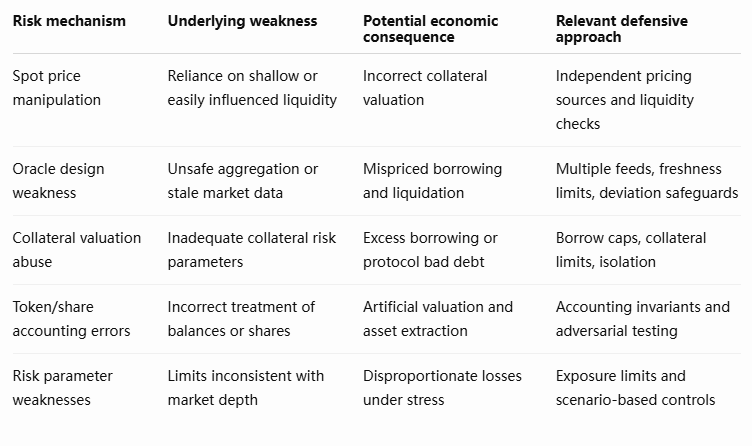
These risk categories should not be understood as interchangeable or solvable through a single mechanism. A robust external oracle may reduce exposure to certain spot-price attacks while doing little to prevent an internal vault-accounting error. Similarly, stricter borrowing limits may limit the damage associated with collateral mispricing without correcting the flawed valuation itself. Defensive design requires a layered assessment of the assets involved, the liquidity available to support their prices, the conditions under which they can be borrowed against, and the accounting rules determining claims on underlying funds. The objective is to prevent temporary or artificial market conditions from generating disproportionate, irreversible financial obligations.
What Should DeFi Risk Management Measure?
DeFi security analysis has traditionally emphasized smart-contract audits, identified coding vulnerabilities, and the total value lost in high-profile incidents. These remain important indicators, but the increase in reported price-related attacks suggests that protocol risk management should pay greater attention to economic exposure. Lending platforms need to understand not only whether their oracle prices are technically accurate under ordinary conditions, but also whether the underlying markets contain enough liquidity to support the collateral valuations used in financial transactions. Risk parameters should reflect the possibility of abrupt price dislocations, concentrated holders, and correlated changes across related assets. Protocols relying on vault shares or tokenized collateral must additionally test how accounting calculations behave when balances change in ways that differ from normal deposits, withdrawals, or transfers.
The risk of economic exploitation also varies with protocol scale and design. A relatively small protocol can experience frequent attacks but limited absolute financial losses because the available capital is modest. A larger lending platform may face less frequent incidents yet suffer a much greater loss when a core collateral or accounting assumption fails. As a result, security dashboards should distinguish incident frequency, loss severity, exposure concentration, asset liquidity, and recoverability. Monitoring the amount of capital at risk relative to available market liquidity may provide more useful advance warning than observing historical exploit totals alone. Continuous stress testing, conservative listing standards, independent price validation, and transaction-level anomaly detection can improve resilience, although none can eliminate every form of economic risk.
The industry also needs consistent classification standards. Treating every flash-loan-assisted exploit as a price manipulation event obscures differences between temporary market distortion, faulty accounting, privileged access abuse, and other vulnerabilities. More detailed incident reporting can help developers identify recurring failure mechanisms and evaluate whether defensive changes are effective. For example, MEXC News has documented the Makina exploit involving oracle manipulation and asset valuation, illustrating how dependencies on external liquidity information can create financial consequences when pricing assumptions break down. Such cases are most informative when the affected valuation mechanism and the resulting economic exposure are clearly separated from the broader category of DeFi hacks.
MEXC View: Attack Frequency Is a Structural Warning
The rise in reported incidents suggests that decentralized finance should increasingly evaluate economic security as a distinct discipline alongside software security. Smart contracts can implement transactions exactly as written while still allowing economically harmful outcomes when prices, collateral limits, or share calculations depend on assumptions that fail under extreme conditions. This makes the quality of financial design increasingly important as DeFi applications become more interconnected. New products introduce additional interactions among lending markets, liquidity pools, derivatives, and tokenized assets, creating opportunities for both legitimate capital efficiency and unexpected risk transmission.
The concentration of losses further indicates that security performance cannot be summarized through one headline number. Frequent smaller incidents may reveal persistent weaknesses across a broad range of applications, while extreme losses identify systems where flawed valuations can affect substantial capital. From a market-structure perspective, the most relevant question is whether DeFi protocols are improving their ability to limit the financial consequences of abnormal inputs. More conservative collateral policies, better liquidity-adjusted pricing, stronger accounting invariants, and independent risk monitoring could reduce potential damage even if attempted manipulation remains common. The long-term credibility of DeFi will depend on demonstrating resilience under adverse economic conditions, not merely increasing the number of completed security audits.
More Attacks Expose Risks Beyond Headline Losses
The increase to 43 reported DeFi price manipulation incidents in 2026 provides evidence that economic vulnerabilities remain widespread across decentralized financial applications. The comparison with 27 incidents in 2022 illustrates a notable rise in the recorded annual count, but the associated loss data reveal why security performance cannot be understood through frequency alone. Approximately $199 million in reported losses was heavily concentrated in one incident, while many other events involved substantially smaller amounts. This combination suggests that the industry faces both recurring localized weaknesses and occasional failures capable of causing disproportionate damage.
DeFi Price Manipulation Attacks also expose a broader challenge in the design of blockchain-based financial services. Lending, collateral management, tokenized vaults, and decentralized liquidity systems depend on financial assumptions that can become unreliable under adversarial conditions. Even where the smart contract code executes correctly, weak price references, excessive collateral permissions, or incorrect accounting relationships can allow economic value to be extracted. The most important protective measures therefore extend beyond conventional coding audits to include stress testing, conservative risk limits, liquidity-aware valuations, and monitoring systems designed to detect abnormal financial behavior.
Future analysis should prioritize changes in incident frequency relative to the number of active protocols, losses adjusted for capital exposure, concentration among the largest events, and improvements in the classification of attack mechanisms. Researchers should also track whether updated oracle systems, collateral constraints, and accounting safeguards measurably reduce losses under comparable market conditions. Such evidence would provide a stronger basis for evaluating security progress than absolute incident counts alone.
The central lesson of 2026 is not simply that DeFi attacks have become more frequent. It is that protocol security must be evaluated through the economic consequences of abnormal market inputs, with particular attention to the rare failures capable of overwhelming ordinary financial safeguards. The industry's ability to manage that risk will be an important determinant of its long-term financial credibility.
Sources
DefiLlama — Hacks and Exploits Database:
https://defillama.com/hacks
RootData — 43 DeFi Price Manipulation Attacks in 2026, October 25, 2026:
https://www.rootdata.com/news/801504
BlockBeats — DeFi Price Manipulation Attack Statistics:
https://en.theblockbeats.news/flash/373610
Risk Disclaimer: This article is for reference only and does not constitute investment advice. The cryptocurrency market is highly volatile. Please make decisions cautiously based on your individual circumstances.