
Bitmine is about to complete its goal of holding 5% of Ethereum and plans to stop increasing its holdings. The article summary is as follows:
- Bitmine's holdings have reached 4.9% of the total ETH supply, only about 77,000 ETH short of the target, which could be completed in as fast as six to seven weeks.
- The company has recently slowed its pace of accumulation and plans to stop buying after reaching 5%, but may reassess in 2027.
- The hoarding strategy has resulted in an unrealized loss of about $5 billion, but Chairman Tom Lee remains optimistic, believing it is advantageous before the bull market.
- After completing the target, the strategic focus will shift to shareholder returns and valuation repair, including share buybacks and using staking income to cover operating costs.
- The company plans to sell staking rewards, but the selling pressure is limited, averaging about $1.1 million per day.
- Other buying forces in the market (such as spot ETFs and other DAT companies) are currently unable to fill Bitmine's gap, but there is still the possibility of new funds entering in the long term.
Author: Nancy, PANews
Ethereum's largest buyer, Bitmine, is about to hit the brakes on increasing its position. In just over a year, Bitmine is one step away from its set goal of 5% of Ethereum's supply, which was originally a five-year long-term plan.
Even as its unrealized losses have continued to expand, this Ethereum treasury company has not stopped hoarding coins, becoming one of the important buying forces supporting ETH. Once Bitmine stops sweeping up coins, who will take over as the next buying force for ETH?
In just 16 months, BitMine is about to complete the "5% alchemy"
Ethereum's biggest bull, Bitmine, is about to complete the "5% alchemy".
Since launching its ETH reserve strategy in June 2025, Bitmine has been continuously buying ETH almost every week and has quickly grown into the world's largest Ethereum treasury company. Now, this layout originally planned to take five years has entered its final stage ahead of schedule.
Bitmine's official announcement shows that as of October 11, the company holds 6,028,946 ETH, accounting for about 4.9% of the total ETH supply (122.1 million), and has completed about 99% of its 5% holding target.
In other words, Bitmine is only about 77,000 ETH away from the target. If calculated based on the recent weekly increase of more than 12,000 ETH, the company could reach the target in as fast as six to seven weeks. This means that Bitmine is expected to fulfill its promised target ahead of schedule about 16 months after launch.
Looking at the pace of accumulation, Bitmine has significantly slowed its coin purchases in recent months. Since June this year, its weekly increase has gradually shrunk from the previous 100,000 or even 200,000 ETH to tens of thousands or even lower. Although the direction of continued buying has not changed, it can be seen that Bitmine is actively adjusting its hoarding pace.
The aggressive hoarding strategy has also put considerable book pressure on Bitmine. Based on an average ETH holding price of $3,334, Bitmine's current unrealized loss is about $5 billion. In response, Bitmine Chairman Tom Lee remains optimistic. He said that most of the company's ETH holdings were accumulated during the crypto market bear market, so before the next crypto bull market he expects, Bitmine is already in a relatively favorable position.
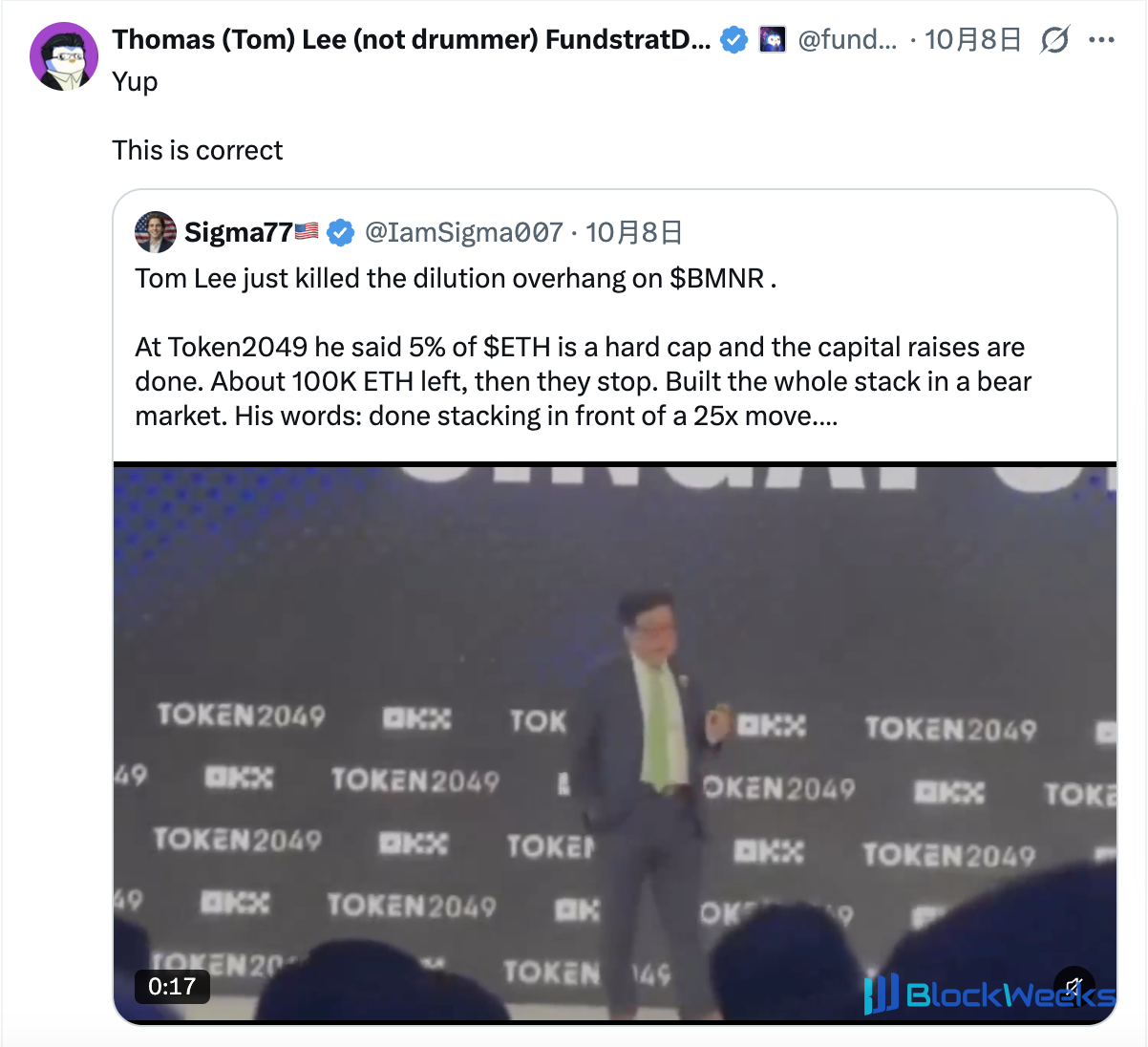
"We will not continue to increase holdings after exceeding 5%, nor will we hold more than 5% of Ethereum's total supply." Tom Lee clearly stated at the Token2049 conference in Singapore that BitMine has set 5% as a hard cap on holdings.
It should be noted that Tom Lee said in an interview with Bankless a few months ago that as more and more companies begin to view ETH as a long-term reserve asset similar to real estate, it may also become reasonable for Bitmine to hold more than 5% of ETH's total supply. He also revealed that the company may reassess this holding target in 2027, mainly based on Ethereum's adoption rate and ecosystem development.
Perhaps 5% is not necessarily Bitmine's absolute long-term holding cap. Whether to continue increasing holdings in the future still depends on the development of the Ethereum ecosystem and the company's own capital operation strategy.
Strategic focus may shift to valuation repair, covering financial expenses by selling staking rewards
For now, Bitmine has chosen to press the pause button after its holding target is about to be reached, which may be behind both the healthy development of the Ethereum ecosystem and its own stock price performance.
From the perspective of ecosystem building, Tom Lee has publicly explained many times that BitMine set its ETH holding target at 5% in the hope of holding a sufficient scale of ETH without disturbing the ecosystem, thereby exerting a positive influence. In his view, 5% is both a holding ratio that can have a substantial impact and can provide important long-term support for the Ethereum ecosystem, becoming a "ballast" for network development.
On the other hand, BitMine itself also faces stock price pressure. Over the past year, BMNR's stock price has fallen more than 55.6%. For Bitmine, continuous financing to buy coins is an important means of expanding its ETH reserves, but the equity dilution pressure brought by financing may also drag down the market's valuation of the company's stock.

To boost its stock price, Bitmine has slowed the pace of ETH purchases while launching a share buyback plan. According to official disclosures, between July 14 and August 17, the company repurchased 21 million shares for $350 million. Tom Lee called it the largest share buyback in crypto industry history.
Now, as the scale of hoarding approaches the set holding target, Bitmine's strategic focus may shift to shareholder returns and valuation repair. Tom Lee pointed out in a recent speech at Token2049 Singapore that after reaching the established holding target, BMNR is expected to outperform ETH because the company no longer needs to continuously finance to buy coins, and the market's concerns about equity dilution are also expected to ease.
After completing the hoarding target, it does not mean that Bitmine will sell its core ETH holdings for financial needs. Tom Lee recently said that most DAT companies holding large amounts of assets may ultimately need to sell some assets to pay operating expenses, repay debt, or distribute profits to shareholders. But BitMine's situation is different: ETH can continuously generate income through staking, and existing staking income is already sufficient to cover preferred stock dividend expenses, thereby reducing the need for the company to sell core ETH holdings to meet financial obligations.
It is reported that Bitmine currently stakes 5,067,309 ETH, with annualized staking income of $336 million; if all holdings are staked, based on a 7-day staking yield of 2.61%, annualized income is expected to reach $400 million.
However, Tom Lee also clearly revealed that Bitmine will sell the staking rewards it receives. In his view, selling core ETH holdings may mean changing the existing strategy, while selling rewards generated by staking is a way to manage the scale of holdings.
But even based on an annualized income of $400 million after staking all holdings, the average daily selling amount is about $1.1 million, which has limited direct impact on ETH's price.
After the largest buyer stops sweeping, who will fill the gap in the market?
It is undeniable that over the past year or so, Bitmine has not only been an important buying force in the ETH market but also an important participant supporting market confidence.
According to SoSoValue data, as of October 13, the total net asset value of U.S. Ethereum spot ETFs was about $15.83 billion, with a net asset ratio (the ratio of ETF-held asset market value to ETH's total market value) reaching 5.16%. By comparison, the ETH holdings of a single DAT company, Bitmine, are already comparable to the overall holdings of U.S. Ethereum spot ETFs.

More importantly, Bitmine's purchase scale has been able to absorb ETH's new supply to a certain extent. Taking the past 30 days as an example, data from ultrasound.money shows that ETH's new issuance was about 86,000 coins, while Bitmine bought about 72,000 ETH during the same period, equivalent to 75.2% of the new issuance during the same period.
However, if Bitmine stops continuously sweeping up coins, who can take the baton and become ETH's new buying force has also become a topic of market attention.
At present, spot ETFs have not yet shown sufficiently strong absorption capacity. Data shows that U.S. spot Ethereum ETFs have seen net outflows for two consecutive weeks, with $542 million withdrawn just last week, the largest single-week net outflow since January this year. If the capital outflow trend continues, ETFs will not only find it difficult to fill the buying gap Bitmine may leave behind, but may also further increase selling pressure in the market.
The buying capacity of other digital asset treasury companies is similarly limited. At present, SharpLink, the second-largest ETH treasury company, holds ETH accounting for about 0.73% of total supply, far from Bitmine's holding ratio of about 4.9%. Whether in terms of asset reserve scale or the ability to continuously increase holdings, other DAT companies are currently difficult to compare with BitMine.
However, changes in buying forces do not necessarily mean ETH prices will continue to come under pressure; market demand still depends on ETF capital flows, other institutions' allocation willingness, and the risk appetite of the entire crypto market.
For the medium- and long-term trend, Tom Lee remains optimistic. He believes that the next crypto bull market is expected to become the largest in history, driven by multiple factors, including asset tokenization, generational wealth transfer, digital asset treasury companies continuing to absorb market supply, and the crypto industry, as a downstream beneficiary of the AI industry chain, benefiting from the development of artificial intelligence.

In Tom Lee's view, the ongoing wealth transfer may also bring new incremental capital to the crypto market. Because the group inheriting wealth is relatively young, its risk appetite for crypto assets and stocks may be higher, and the impact of this trend in this cycle may exceed that of the 2019 to 2021 bull market.
As for ETH's price outlook, Tom Lee even gave an aggressive forecast. He expects ETH to have the potential to break through $5,000 before the end of this year; if Bitcoin's price breaks through $100,000, ETH is then expected to rise further to about $7,500. His long-term bullish logic lies in the fact that after years of consolidation, Ethereum may usher in a larger-scale price breakout.
Overall, after Ethereum's largest buyer stops adding to its position, the ETH market's absorption capacity may face a test. But the buying pace of a single treasury company cannot determine ETH's long-term trend. As asset tokenization accelerates, institutional allocation demand grows, and the Ethereum ecosystem continues to develop, the market is still expected to welcome new incremental capital, providing new demand support for ETH.