Original | Odaily Planet Daily (@OdailyChina)
Author|Azuma (@azuma_eth)
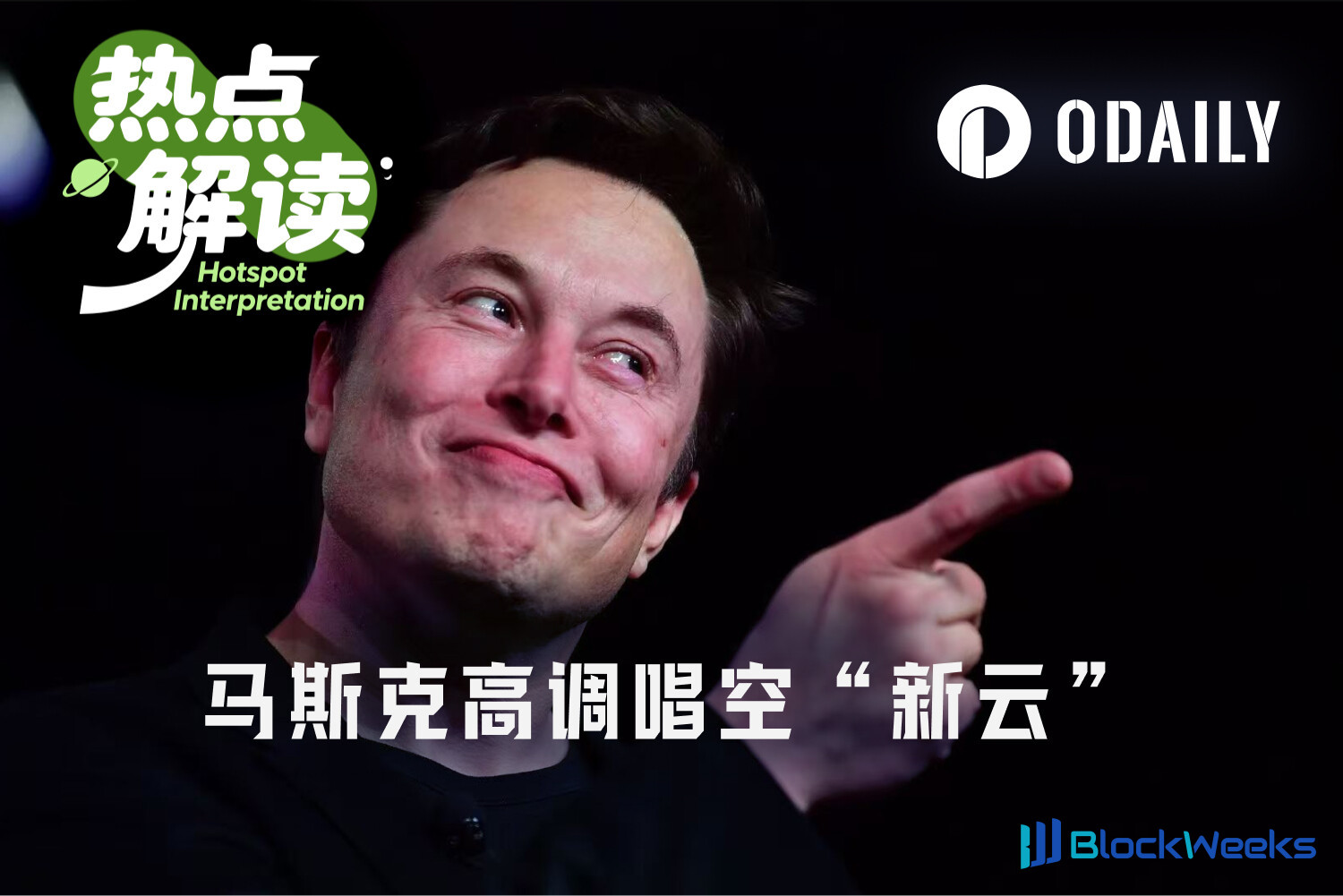
Over the weekend that just passed, Elon Musk dropped a series of predictions on X one after another, throwing a depth charge into the already undercurrent-troubled AI compute infrastructure market.
Facing Silicon Valley's still much-relished "hoard cards and get rich" myth, Musk first coldly predicted that a large amount of compute would be "stranded in half-built data centers," and then directly handed down a death sentence to more than 200 emerging compute cloud vendors (Neocloud) worldwide — with the debt market doors tightly shut, these companies are about to face a "guppy-level death and consolidation."
Interestingly, just a few days before throwing out this "bearish compute theory," Musk had just boasted on SpaceX's Q3 earnings call that its own compute was in short supply, with major cloud vendors and dozens of startups endlessly lining up to rent.
On one side, its own compute is bustling with customers, and it claims to have just finalized a $40 billion massive card-buying loan; on the other side, it loudly declares that peers are about to be wiped out. Are Musk's successive shots this weekend the well-intentioned whistleblowing of an industry pioneer? Or a precisely targeted hunt with a clear goal?
Death Prophecy: From Stranded Compute to Industry Annihilation
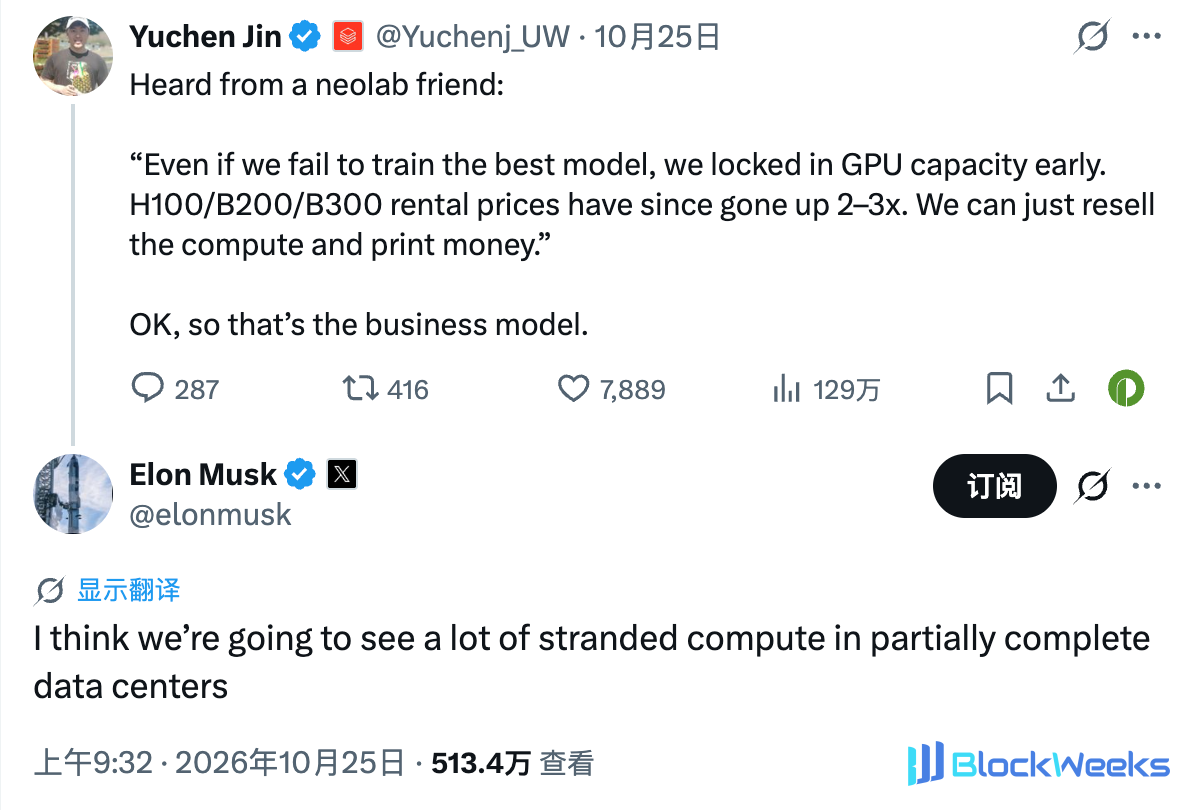
The starting point of this public opinion storm came from an industry anecdote shared on October 25 by Silicon Valley blogger Yuchen Jin. A friend at an AI lab revealed to him the current absurd ecosystem: "Even if we can't train the best models, it doesn't matter. We locked in GPU capacity early. Now the rental prices for H100, B200, and B300 have tripled or doubled, and just reselling compute can directly print money."
Under this tweet that treats "compute middlemen" as a business model, Musk poured the first bucket of cold water: "I think we will soon see a lot of stranded compute, trapped in those half-built data centers."
Immediately afterward, Silicon Valley venture capitalist Chamath Palihapitiya, who holds a large amount of "powered land assets," entered the fray and stood on Musk's side (looking back, one always feels these two had a premeditated plan), publishing a long post that dissected Musk's views frame by frame, pointing directly at 2027 as the "year of brutal clearing" for AI compute infrastructure.
Chamath mentioned that there are now four major problems facing Neocloud vendors.
- Organizational and funding mismatch: Most Neoclouds are chaotically managed and weakly capitalized; while traditional hyperscale cloud vendors (Hyperscalers) are extremely bureaucratic, taking 3 months just to sign a non-disclosure agreement, with hosting periods as long as 18 months.
- Pipeline delays and compute retention in 2027: Delays in the existing infrastructure pipeline will erupt concentratedly in 2027. By then, traditional giants will inevitably prioritize internal demand and forcibly take cuts externally through "model routers." A large number of paid-for GPUs will sit gathering dust in warehouses, with returns far below the cost of capital — "except for one company (suspected to imply SpaceX), everyone will face this problem."
- The physical deadlock of land and power: In West Texas, a compute stronghold, obtaining mineral rights exemptions is slower than ever; East Texas is full of legal risks; power grids everywhere are completely overloaded, and power companies, in order to clear out "placeholders," will inevitably significantly raise the threshold for upfront capital commitments.
- The fatal weakness — liquidated damages (LD) clauses: This is the last straw that breaks the camel's back. Once a Neocloud lacking high-availability compute operations experience encounters construction delays or downtime, it cannot fulfill uptime commitments, and the strict liquidated damages clauses in customer contracts will directly trigger penalties, causing it to lose investment-grade packaging or even be abandoned by major customers.
Facing Chamath's precise knife-handing, Musk then delivered the most lethal follow-up strike: "Pretty much. Over the past few weeks, for any company without a revenue source independent of AI data centers, the debt market has almost completely shut its doors. SpaceX has just finalized $40 billion in debt to buy GPUs, but we are an Investment Grade credit, and we have Starlink and rocket launch revenue as a backstop. This means more than 200 Neoclouds will face guppy-level death and consolidation. A few will survive, but not many."

Musk then also specifically emphasized: "SpaceX will never acquire any Neocloud, because that would be meaningless."
The Eve of the Storm: Why Did the "Borrow Money to Buy Cards" Flywheel Suddenly Jam?
Musk's words may be harsh, but what he hit is indeed the most vulnerable fatal point of the current Neocloud industry — the "cards waiting for power" dilemma of physical delivery has run into the "credit withdrawal wave" of financial markets.
Over the past two years, Neocloud players represented by CoreWeave, Nebius, Crusoe, and others have run through a highly leveraged capital flywheel — first signing 3-to-5-year long-term compute offtake contracts with major customers; then using these contracts and purchased GPUs as collateral to borrow tens of billions in private credit or high-yield bonds from Wall Street; finally buying cards, renting data centers, and collecting rent to repay principal and interest.
However, entering October 2026, this flywheel built on the assumption of "infinite expansion" hit sudden brakes simultaneously on the physical end and the funding end:
The first heavy blow comes from the shift of the physical bottleneck, namely the market has gone from "short on chips" to "short on sockets." As Musk warned as early as 2024, the AI bottleneck transmits along the path of "chips → transformers → power." Now Nvidia's graphics cards are shipping continuously, but supporting substations, grid connection permits, cooling systems, and powered data center shells are severely lagging. Once the astronomically priced graphics cards are stuck in half-finished construction sites and cannot be plugged in, they cannot generate even a cent of rental cash flow.
The second heavy blow comes from creditors' panic and time mismatch. Graphics cards gather dust in warehouses, but the creditors' interest calculation table does not stop for even a second. Just ten days before this war of words broke out (October 13 to 16), industry leader CoreWeave had just experienced a brutal "double kill of stocks and bonds":
- Although CoreWeave holds a contract backlog of up to $104.2 billion, its total on-book debt has snowballed to $35.6 billion (if $16.3 billion in lease liabilities are included, broad debt commitments exceed $51 billion); net interest expense in the second quarter alone reached $640 million, far exceeding its operating cash generation capacity, directly dragging the company into a massive net loss of $626 million.
- In mid-October, the bond market was the first to strike. Yields on CoreWeave bonds maturing in 2032 and 2031 soared, successively hitting the 15%–16% junk-bond crisis level (bond prices fell below 80 cents on the dollar), five-year credit default swaps surged to 1,000–1,200 basis points (implying a default probability of over 60% in the next five years), and the stock price plunged more than 20% in a single week.
- It is worth noting that on October 13, the day CoreWeave bond yields spiked, Chamath posted a chart on X with a "👀" emoji, and Musk left a comment underneath saying "Yikes," and the next day CoreWeave's stock price directly plunged 15% — and combined with the weekend just past, this was already the second time in half a month that the two had echoed each other in a coordinated move to short peer sentiment.
This is the truth behind what Musk calls the "death loop." The money Neoclouds use to buy cards must be paid immediately, while a backlog of more than $100 billion can only turn into cash over several years; once data center power-on is delayed and financing rates soar to 15%, the liquidity gap in between instantly becomes a black hole that devours the company.
Whistleblower or Hunter? Musk's Open Conspiracy
Once you understand the fragility of the industry and then look back at Musk's sudden bearish call, you will realize that this is by no means a simple "industry risk warning," but a commercial sniper attack with timing honed to the extreme. Because in this crisis, Musk happens to be the biggest potential beneficiary.
First, look at SpaceX's real cards today. With the deep integration of its AI business into its "Super Intelligence" (SI) division, SpaceX today is no longer just an aerospace and satellite communications company, but the world's most ferocious AI compute giant.
On October 21, SpaceX said in its just-disclosed third-quarter 2026 financial report:
- SpaceX's third-quarter total revenue surged 161% to $14.575 billion, with net profit reaching $4.4 billion;
- Among that, the Super Intelligence division's single-quarter revenue reached as high as $7.56 billion (up about 830% year over year), historically surpassing the connectivity business where Starlink sits ($5.248 billion) and the space launch business ($1.767 billion), accounting for more than half of the company's total revenue;
- As of the end of September, SpaceX's nameplate compute scale had reached 1.7 gigawatts, single-quarter capital expenditure reached as high as $19.59 billion (of which $16.44 billion was poured into the SI business), and it had just completed $40 billion in off-exchange chip financing through private debt, used to purchase Nvidia GPUs arriving in the first and second quarters of next year.
With this financial report on the table, the three layers of motivation behind Musk's repeated bombardment of Neoclouds become obvious.
The first is a dimensional strike at the business model level — "power waiting for cards" beating "cards waiting for power," and "high spot premiums" beating "signed low-price long-term contracts."
Most Neoclouds need to rely on third-party commercial real estate developers to build data centers, and in order to get bank loans, they have to sign 3-to-5-year locked-price long-term contracts with customers; and in today's environment of compute scarcity, long-term contracts signed in earlier years instead lock in low profit margins.
By contrast, SpaceX, relying on the industrial-grade vertical integration capability it has demonstrated in places such as Memphis, takes the "power waiting for cards" route — next year it plans to prepare 20 gigawatts of power and cooling capacity to match 10 gigawatts of compute. More critically, SpaceX relies on Starlink and rocket launches to generate more than $10 billion in stable cash flow and investment-grade credit each year, and simply does not need to sign low-price long-term contracts to beg banks for loans. Therefore, when SpaceX tells peers who have cards but cannot plug them in that "your compute will be stranded," it is essentially declaring to the whole market: "Only I have ready-made power and sockets here."
The second is psychological warfare and pulling the rug out from under them — scaring off peers' customers and creditors.
As market observers have pointed out, despite Neoclouds' high debt, as long as customers continue to place orders and operating cash flow maintains high growth, most leading players still have a chance to trade time for space and survive the difficulties.
Musk's ruthlessness lies in the fact that on the surface he is talking down Neoclouds' funding chain, but in reality he is intimidating Neoclouds' downstream customers and upstream creditors. When the world's most influential tech giant publicly asserts that "more than 200 new cloud vendors will die like guppies" and that "the bond market has already closed," which large model company or enterprise customer would still dare to hand mission-critical compute business to a new cloud vendor that "could blow up at any time"? Once customers turn to SpaceX out of panic, or banks further tighten refinancing, Neoclouds that could originally have survived will also fake it till they make it because of a broken cash flow.
The third is a stance game at the industrial chain level — Jensen Huang certainly hopes all buyers stay alive, but Musk only wants peers to die sooner.
Comparing Musk's statement with Nvidia CEO Jensen Huang's remarks a few days earlier makes the subtlety of the commercial game even more apparent. Just as CoreWeave was crashing in mid-October, Nvidia, which holds about 10% of its shares, immediately had Jensen Huang step forward to support it, stressing that Neocloud demand is off the charts and funding problems will eventually be resolved.
The reason for the different attitudes of Musk and Jensen Huang is simple. Jensen Huang is the one "selling shovels"; he needs all the Neoclouds buying cards to stay alive in order to maintain Nvidia's premium and a diversified buyer ecosystem; while Musk is both a super buyer of chips and a dealer directly selling compute himself. If peers go bankrupt, not only will the freed-up Nvidia high-end chip quotas be swallowed up by SpaceX in due course, but overflow high-end compute tenants will also be forced to flow to SpaceX.
As for Chamath, who has been playing a "double act" with Musk all along, in August he also publicly said that he and his partners had already acquired nearly 6 gigawatts of grid power and behind-the-meter generation capacity, and that this capacity would ramp up and connect to the grid in batches from now until 2029. In other words, Chamath is holding nearly 6 gigawatts of already-powered data center land and waiting to sell at a high price — the more he hypes the panic of "cards waiting for power" in 2027, the more his "powered land" can sell for sky-high prices.
AI May Not Usher in a Winter, but Compute Infrastructure Is Due for a Shakeout
It should be objectively pointed out that Musk's claim that "the bond market is completely closed" still carries a certain degree of exaggeration. Not long before he made the remark, Nebius had just obtained a $3.5 billion loan led by Citigroup, and Lambda also obtained $1 billion in investment-grade financing earlier in the month. Capital has not fled the AI infrastructure sector, but the rough-and-tumble era of indiscriminate money-throwing has indeed ended.
But it must be admitted that the public opinion tsunami triggered by Musk is accelerating the structural turn of the AI compute market from the end of 2026 to 2027.
In this shakeout, the capital market's evaluation criteria for compute companies have quietly changed dramatically, shifting from simply valuing backlog growth to a brutal focus on debt-servicing capacity and cash flow duration matching. All-around giants with non-AI independent cash flow and investment-grade ratings can still borrow tens of billions of dollars at extremely low cost, while "one-legged" Neoclouds that rely purely on borrowing to buy cards and lack their own cash-generating ability will be forced to bear punitive financing costs of 12%–15% or more, ultimately becoming prey for giant mergers or asset liquidation.
At the same time, the industry's competitive barrier has also completely shifted from the early "grabbing GPUs" to "grabbing power and delivery certainty." 2027 will ruthlessly test the engineering delivery foundation of all major compute players: whoever can secure land and mining rights, overcome grid connection queues, and quickly deliver high-availability data centers with power and liquid cooling will be able to feast on high-premium spot dividends; conversely, no matter how many high-end chips are hoarded, in the face of strict penalty clauses for breach of contract they will only become depreciating negative assets.
Under this pressure, the downstream buyer group is also differentiating, with leading closed-source large model vendors sparing no expense to snap up high-certainty spot compute from SpaceX, while more traditional enterprises are beginning to bypass middlemen and build their own small and medium-sized data centers to run open-source models, in pursuit of data security and controllable costs.
In the final analysis, Musk's "stranded compute theory" is not sounding the whistle of winter for the AI industry; on the contrary, it declares that AI compute has moved from "PPT land-grabbing plus leverage" into a new cycle of "competing on balance sheets and heavy-industry delivery capability." In this shakeout that is about to fully erupt in 2027, demand is still scorching hot, but most of the "guppy" chips at the table are destined to be swept into the pockets of the great sharks at the top of the pyramid.