












Original | Odaily Planet Daily (@OdailyChina)
Author|Azuma (@azuma_eth)

In the early hours of this morning, Binance's hot wallets suffered the largest security breach in cryptocurrency history. Within less than an hour, Binance hot wallets across multiple networks including Ethereum, Bitcoin, Tron, as well as Arbitrum, Avalanche, Optimism, Base, and others were simultaneously compromised, with cumulative outflows approaching $6.3 billion (as confirmed in Binance's latest announcement).
Following the attack, major stablecoin issuers, RWA asset issuers, and public chain protocols launched the largest joint on-chain interception operation in crypto history.
As of 8:52 Beijing time, Binance officially updated the incident handling progress, stating that the total amount of stolen assets confirmed frozen is approximately $3 billion. Binance also stated that the team continues to work closely with law enforcement agencies, asset issuers, blockchain intelligence companies, and industry partners to trace and freeze more assets, and will only publish verified data going forward.
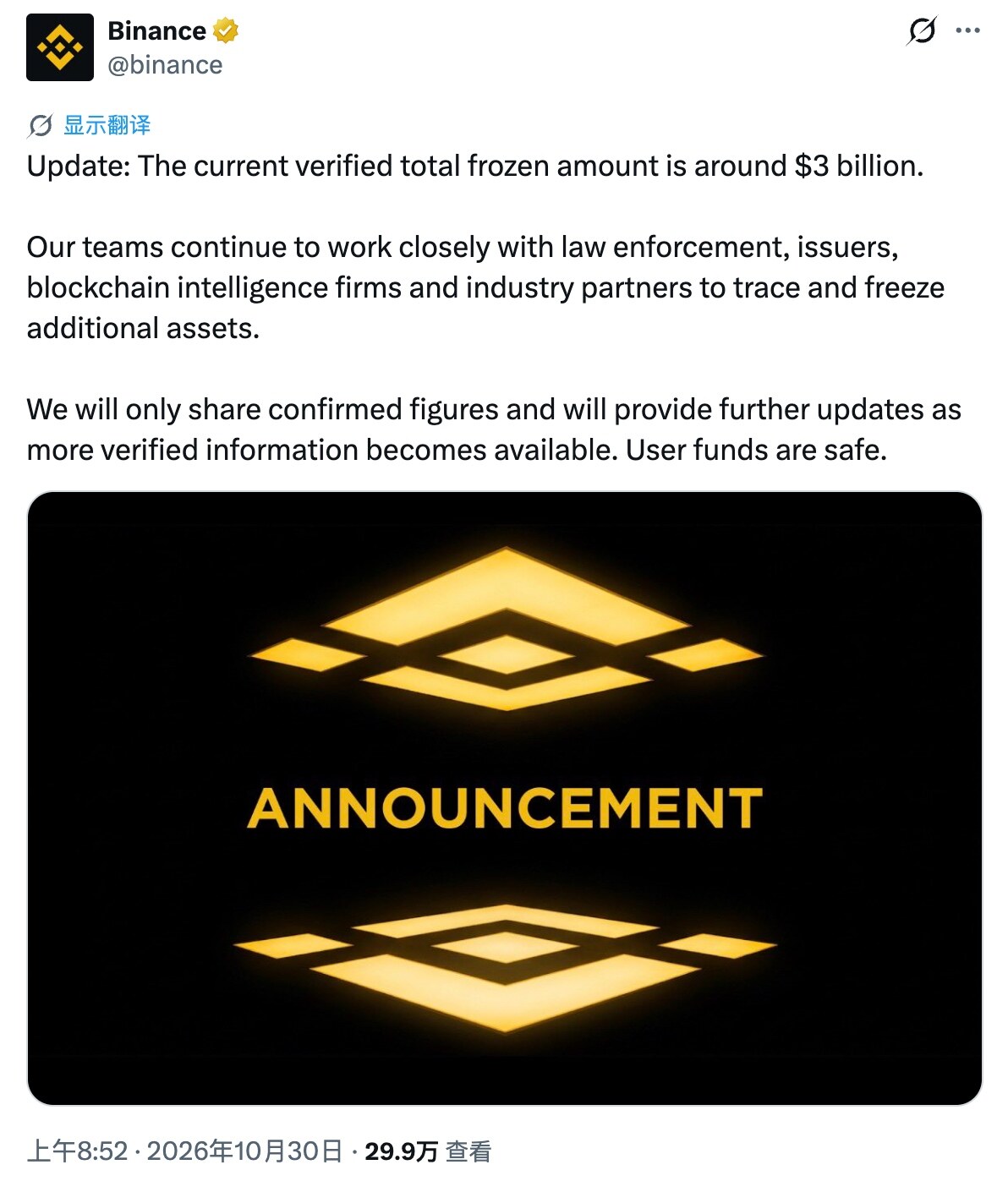
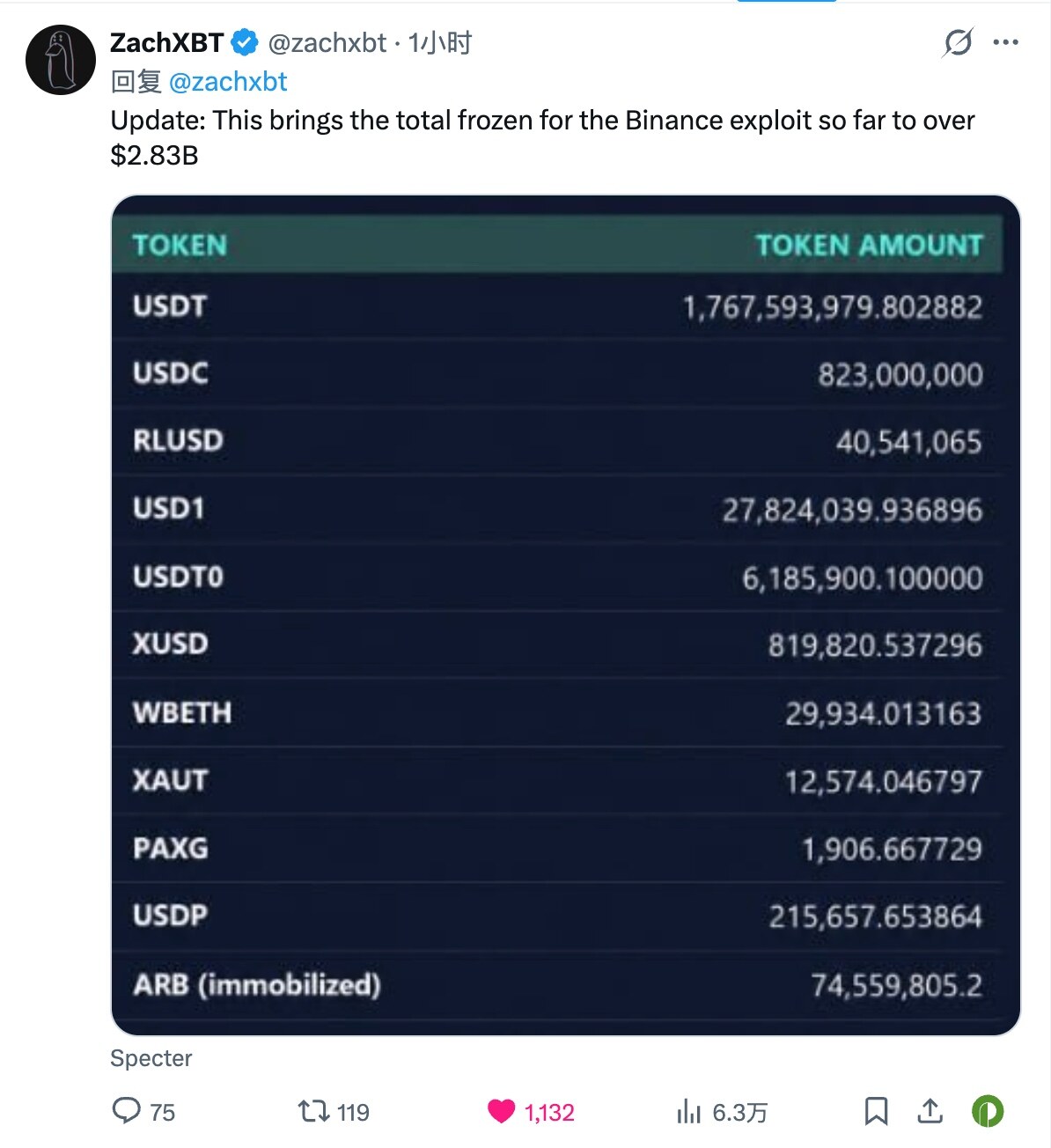
Combining the community's latest on-chain tracking dashboard data (source: ZachXBT) and timeline records, we have compiled the 11 types of assets confirmed to have been frozen by various institutions/protocols as of the time of publication.
Breakdown of the Freezing Operation: Who Is Acting? How Are They Intercepting?
This on-chain interception of up to $3 billion mainly relies on the built-in blacklist or freeze administrator permissions of centralized stablecoins and yield-bearing asset smart contracts, and can be specifically divided into the following four major categories.
Stablecoin Duo: Tether and Circle Lock Down Nearly $2.6 Billion
- Tether (froze over $1.809 billion)
On-chain records show that just 41 minutes after Binance 14 was first swept at 4:24 Beijing time, Tether took the lead at 5:05 by calling the blacklist function on-chain, initially locking 971 million USDT, and at 5:11 expanded the freeze to 1.567 billion USDT.
Subsequently at 5:25, Tether CEO Paolo Ardoino officially posted on X confirming that over 1.567 billion USDT related to the Binance incident had been frozen. With the subsequent blacklisting of additional associated addresses, current on-chain statistics show that a total of 1,767,593,979.80 USDT has been completely locked down.
At the same time, Tether also blacklisted 12,574.05 XAUT (gold token, approximately $35 million) that the hacker casually swept out, as well as 6,185,900.10 USDT0, a cross-chain stablecoin.
- Circle (froze $823 million)
After Binance 34 outflowed a total of 823 million USDC at 4:41 and 4:59, Circle completed the on-chain address blacklisting at 5:13. Subsequently at 5:28, Circle CEO Jeremy Allaire officially posted on X confirming that over 800 million associated USDC had been frozen in coordination with law enforcement.
Selon les dernières statistiques on-chain, les 823 000 000 USDC volés ont été entièrement gelés dans les adresses du hacker.
Émetteurs de stablecoins émergents : Ripple, WLFI, Paxos et StraitsX rejoignent le siège
Outre les deux plus grands géants des stablecoins, d'autres émetteurs de stablecoins émergents ont également participé au siège contre le hacker.
- Ripple : a gelé 40 541 065 RLUSD (environ 40,54 millions de dollars) dans les adresses du hacker ;
- World Liberty Financial : a gelé 27 824 039,94 USD1 (environ 27,82 millions de dollars), ainsi que 48 millions de jetons WLFI (environ 2 millions de dollars) ;
- Paxos : a simultanément gelé 215 657,65 USDP (environ 215 000 dollars) de son stablecoin émis et 1 906,67 PAXG (environ 5,3 millions de dollars) de son jeton adossé à l'or ;
- StraitsX : l'émetteur de stablecoins conforme à Singapour StraitsX a gelé 819 820,54 XUSD (environ 820 000 dollars).
Actifs enveloppés propriétaires de Binance : près de 30 000 WBETH verrouillés sur place
Parmi les actifs non-stablecoins, le hacker a balayé 29 934,01 WBETH (Wrapped Beacon ETH, d'une valeur de près de 80 à 100 millions de dollars) depuis Binance 14.
Étant donné que le WBETH lui-même est un jeton enveloppé de staking liquide officiellement émis par Binance, son contrat intelligent sous-jacent dispose de permissions de restriction administratives. L'équipe de sécurité de Binance a immédiatement gelé ce lot de WBETH via des permissions internes après l'incident, et le hacker ne peut plus le désengager ni le vendre.
Confinement de l'écosystème des chaînes publiques : 74,56 millions d'ARB empêchés de circuler
Outre les actifs directement gelés via les listes noires des contrats de jetons mentionnés ci-dessus, d'autres écosystèmes de chaînes publiques (L1 & L2) prennent également activement des mesures d'urgence pour contenir la situation.
À 8 h 19, heure de Pékin, ce matin, le Conseil de sécurité d'Arbitrum a officiellement annoncé avoir pris des mesures d'urgence pour transférer 74 559 805 ARB et 8 425 ETH détenus dans des adresses identifiées comme liées à l'incident de piratage de Binance vers un portefeuille intermédiaire gelé. Les adresses qui détenaient initialement ces fonds ne peuvent plus y accéder, et ils ne peuvent être transférés que par une action ultérieure du Conseil de sécurité ou un vote de gouvernance de l'Arbitrum DAO, les questions pertinentes devant être coordonnées avec toutes les parties.
Points de suivi ultérieur
Avec environ 3 milliards de dollars de fonds volés gelés, la grande majorité des actifs en stablecoins entre les mains du hacker a été maîtrisée.
Actuellement, le cœur du suivi on-chain et de l'offensive-défensive s'est entièrement déplacé vers les actifs cryptographiques natifs qui ne peuvent pas être directement gelés via des contrats — principalement environ 195 000 ETH encore en circulation ou dormants on-chain (dont une partie a été déposée par le hacker dans Aave pour emprunter du WETH afin de tenter de blanchir) et 18 270 BTC sur le réseau Bitcoin.
Concernant les mouvements anormaux on-chain des fonds restants non gelés et l'avancement de la récupération judiciaire, Odaily Planet Daily continuera d'assurer un suivi. Avec tout le réseau qui se referme, quels fonds sales ont été gelés dans l'incident de vol de Binance ?